Inside the Canvas
Tip: move over the painting to use the lens.
Las Meninas
Diego Velázquez · 1656
A princess, a king, and a puzzle: what's really happening in this 17th-century masterpiece?
- Artist
- Diego Velázquez
- Date
- 1656
- Where to see it
- Museo del Prado
Museo del Prado · Public domain · image via Wikimedia Commons · see it at the museum ↗
Updated 13 October 2026 · how we write
The story
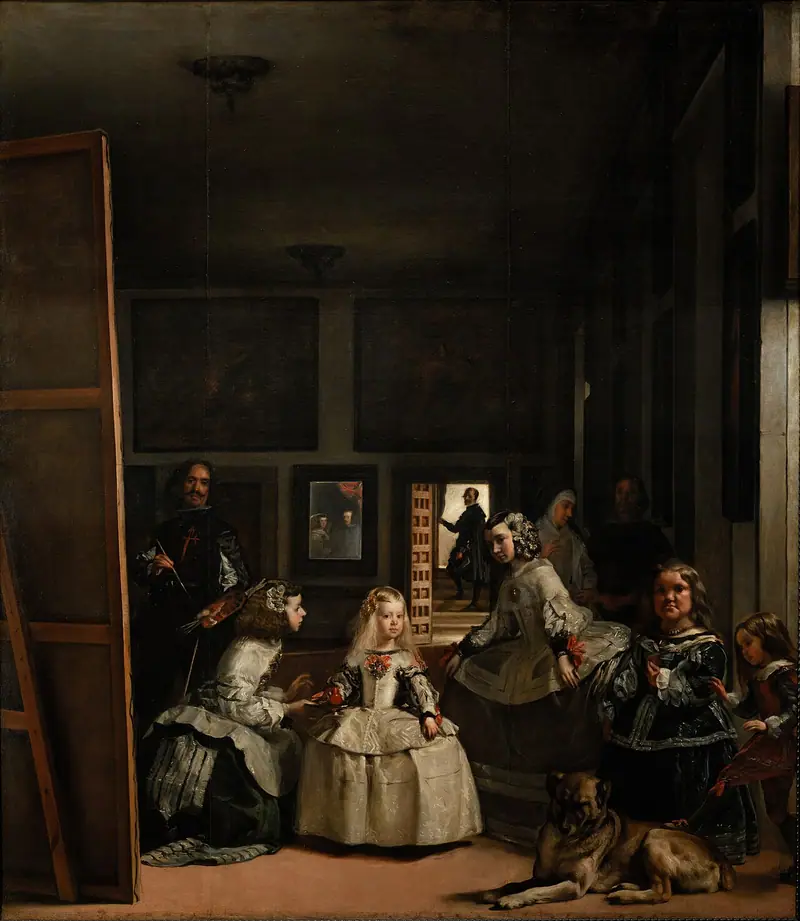
Diego Velázquez, a Spanish Baroque painter, created this 1656 oil painting, one of the most analyzed works in Western art. It's a complex composition that raises questions about reality and illusion. The painting features a princess, a king, and a royal court, but what's really happening behind the scenes?
The painting is full of symbolism and hidden meaning, making it a true masterpiece of art. The way the artist has captured the figures and the atmosphere is truly breathtaking.
Our perspective
Our own reading of the picture - an opinion, not a fact.
As you stand in front of this painting, you can't help but feel like you're part of the royal court, observing the intimate moments of the princess and the king. It's like being a fly on the wall, getting a glimpse of the royal family's private life. But, as you look closer, you start to wonder if there's more to the story than meets the eye.
This painting asks us questions about the nature of reality and our place in it. Are we just observers, or are we part of the action?
Slow Look
- The princess Notice the subtle smile on her face, a sign of her gentle nature.
- The king Take a moment to appreciate the king's regal presence, captured with precision and detail.
- The maids of honor Observe the way the maids of honor are arranged, a subtle reflection of the social hierarchy of the time.
- The artist himself Look closely and you'll spot Velázquez, the artist, painting the scene, a clever play on the concept of reality and illusion.
- The background Take a step back and notice the stunning background, a beautiful representation of the palace and the city.
About Diego Velázquez
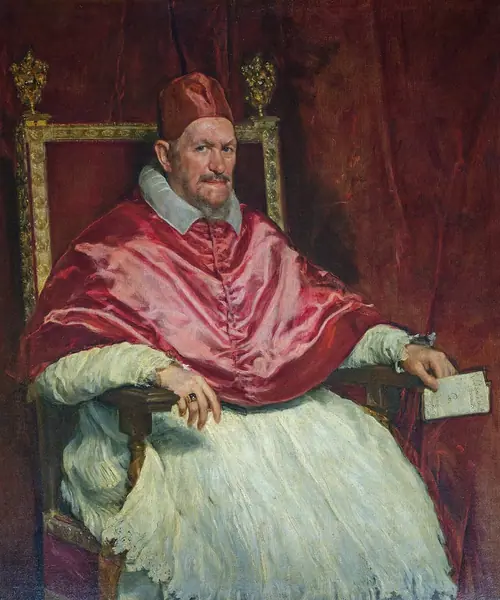
Diego Velazquez (1599-1660) was born in Seville and became court painter to King Philip IV of Spain in 1623, a post he held for the rest of his life. He painted the royal family, courtiers and ordinary people with the same direct, loose brushwork. On a trip to Rome he painted a celebrated portrait of Pope Innocent X (1650). His Las Meninas (1656), now in the Prado, is one of the most studied paintings in the world. Edouard Manet later called him the painter of painters.
Questions about Las Meninas
What is the story behind Las Meninas?
Diego Velázquez, a Spanish Baroque painter, created this 1656 oil painting, one of the most analyzed works in Western art. It's a complex composition that raises questions about reality and illusion. The painting features a princess, a king, and a royal court, but what's really happening behind the scenes?
Who painted Las Meninas?
Diego Velázquez painted Las Meninas.
What is the date of Las Meninas?
Las Meninas is dated 1656.
Where is Las Meninas today?
Las Meninas is held by Museo del Prado.
What is the social hierarchy depicted in Las Meninas?
The Infanta Margarita Teresa stands at the centre, attended by her maids of honour (las meninas). Courtiers, a chaperone, dwarfs and a dog fill the room around her, Velázquez paints himself at the easel, and King Philip IV and Queen Mariana appear only as a reflection in the mirror at the back.
Who are the maids of honor in Las Meninas and what do they represent?
The two maids of honour (meninas) are Maria Agustina Sarmiento, offering the Infanta Margarita Teresa a drink, and Isabel de Velasco on her other side. They show the young princess at the centre of a busy royal household.
What is the purpose of the background in Las Meninas?
The background in Las Meninas represents the palace and the city, creating a stunning and beautiful composition.
Keep reading
- Mona Lisa Leonardo da VinciShared themes: painting
- A Sunday Afternoon on the Island of La Grande Jatte Georges SeuratShared themes: painting
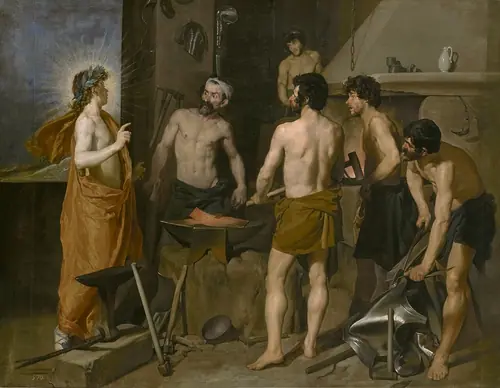
- Apollo in the Forge of Vulcan Diego VelázquezAlso by Diego Velázquez
What do you see?
Stand in front of it for a moment. Then tell us what you noticed or felt - there are no wrong answers.
Be the first to share a thought.
More by Diego Velázquez
If you like this, stand in front of these