Inside the Canvas
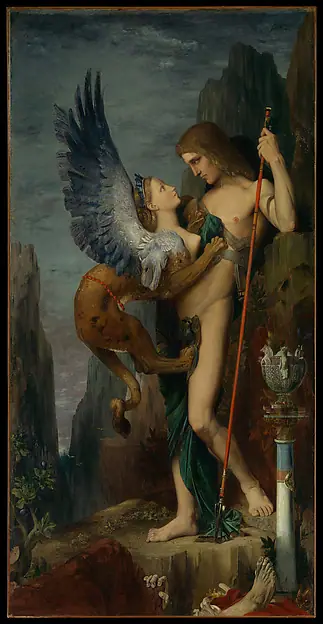
Tip: move over the painting to use the lens.
Oedipus and the Sphinx
Gustave Moreau · 1864
What secrets does the Sphinx hold for Oedipus?
- Artist
- Gustave Moreau French, Paris 1826–1898 Paris
- Date
- 1864
- Medium
- Oil on canvas
- Size
- 81 1/4 × 41 1/4 in. (206.4 × 104.8 cm)
- Where to see it
- The Metropolitan Museum of Art
Bequest of William H. Herriman, 1920 · CC0 Public Domain · The Met · see it at the museum ↗
Updated 24 October 2026 · how we write
The story
Gustave Moreau's 1864 painting, Oedipus and the Sphinx, was a hit at the French Salon that same year. This oil on canvas masterpiece is now part of the Metropolitan Museum of Art's collection. The work is a fresh take on the ancient myth of Oedipus meeting the Sphinx outside Thebes, as described in Sophocles' play Oedipus Rex. It's a painting that showcases Moreau's skill in blending mythological and allegorical themes.
Oedipus and the Sphinx is a testament to Moreau's ability to bring new life to traditional subjects. His work often featured mythological and biblical themes, which he reinterpreted in a unique and captivating way.
As one of the leading figures in the Symbolist movement, Moreau's art often explored the mysteries of the human experience. His paintings, like Oedipus and the Sphinx, invite the viewer to ponder the complexities of the human condition.
Our perspective
Our own reading of the picture - an opinion, not a fact.
As I stand before Oedipus and the Sphinx, I'm struck by the sense of unease that pervades the painting. It's as if the weight of Oedipus' fate is already looming, even as he stands at the crossroads, unsure of what lies ahead. This painting asks us to confront our own mortality and the mysteries that lie beyond our understanding.
In many ways, Oedipus and the Sphinx is a mirror held up to our own lives. We all face our own Sphinx-like challenges, where the answer to our questions lies hidden. This painting invites us to pause, reflect, and seek the answers that lie within ourselves.
Slow Look
- At the Sphinx's enigmatic gaze Notice the intensity of her stare, as if she's sizing you up, and the subtle smile that hints at secrets yet to be revealed.
- At Oedipus' uncertain stance Feel the tension in Oedipus' posture, as if he's poised on the edge of discovery, and the subtle uncertainty in his eyes.
- In the background, the cityscape Observe the faint outlines of buildings and architecture, which serve as a reminder of the world beyond the mythological realm.
- At the play of light and shadow Notice how the lighting creates deep shadows and pools of light, adding depth and dimensionality to the scene.
- At the textures and patterns Feel the intricate textures and patterns in the Sphinx's fur, and the subtle folds of Oedipus' robes.
About Gustave Moreau
Gustave Moreau was a French artist and an important figure in the Symbolist movement. Jean Cassou called him "the Symbolist painter par excellence". He was an influential forerunner of symbolism in the visual arts in the 1860s, and at the height of the symbolist movement in the 1890s, he was among the most significant painters. Art historian Robert Delevoy wrote that Moreau "brought symbolist polyvalence to its highest point in Jupiter and Semele." He was a prolific artist who produced over 15,000 paintings, watercolors, and drawings. Moreau painted allegories and traditional biblical and myth
Text adapted from Wikipedia, Gustave Moreau, licensed CC BY-SA 4.0.
Questions about Oedipus and the Sphinx
What should I know about Oedipus and the Sphinx?
Gustave Moreau's 1864 painting, Oedipus and the Sphinx, was a hit at the French Salon that same year. This oil on canvas masterpiece is now part of the Metropolitan Museum of Art's collection. The work is a fresh take on the ancient myth of Oedipus meeting the Sphinx outside Thebes, as described in Sophocles' play Oedipus Rex.
Who painted Oedipus and the Sphinx?
Gustave Moreau painted Oedipus and the Sphinx.
When was Oedipus and the Sphinx painted?
Oedipus and the Sphinx is dated 1864.
Where can I see Oedipus and the Sphinx?
Oedipus and the Sphinx is held by The Metropolitan Museum of Art.
What medium is Oedipus and the Sphinx?
Oedipus and the Sphinx is listed as oil on canvas.
When was Gustave Moreau's painting Oedipus and the Sphinx created?
Gustave Moreau's painting Oedipus and the Sphinx was created in 1864.
Keep reading
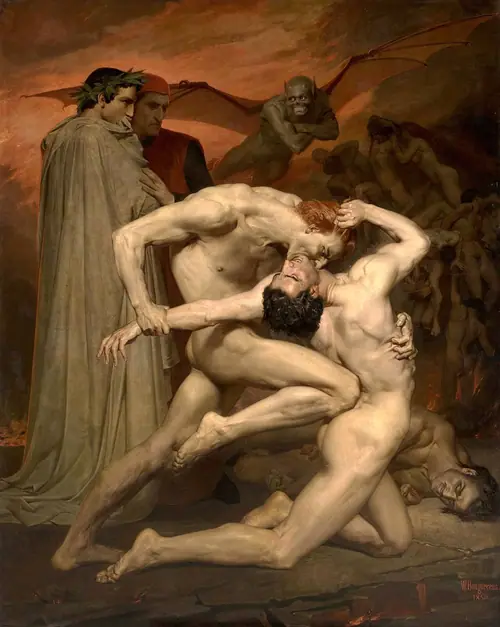
- Dante and Virgil William-Adolphe BouguereauShared themes: 19th century, french art, mythology
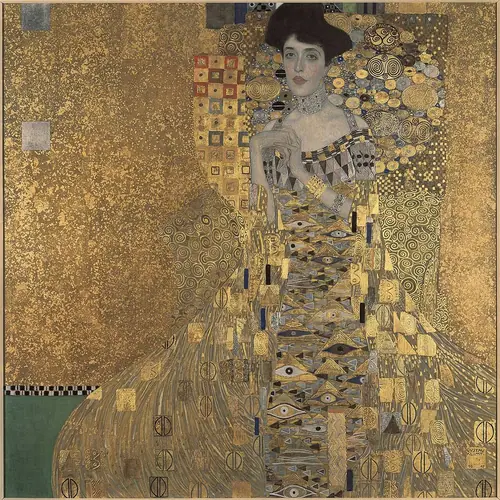
- Portrait of Adele Bloch-Bauer I Gustav KlimtShared themes: ethereal, symbolism
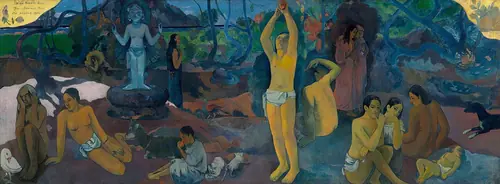
- Where Do We Come From? What Are We? Where Are We Going? Paul GauguinShared themes: mysterious, symbolism
What do you see?
Stand in front of it for a moment. Then tell us what you noticed or felt - there are no wrong answers.
Be the first to share a thought.
More by Gustave Moreau
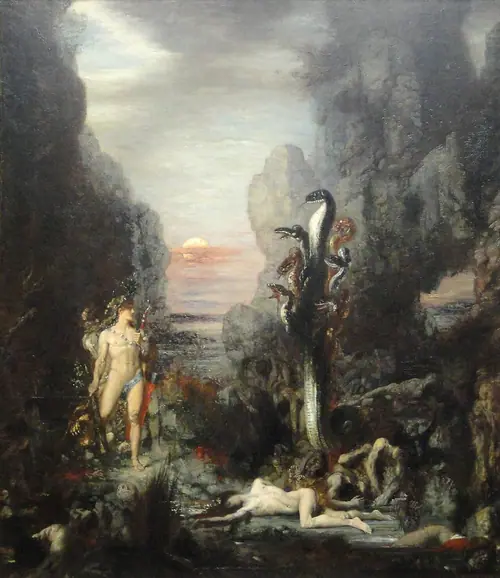
If you like this, stand in front of these