Inside the Canvas
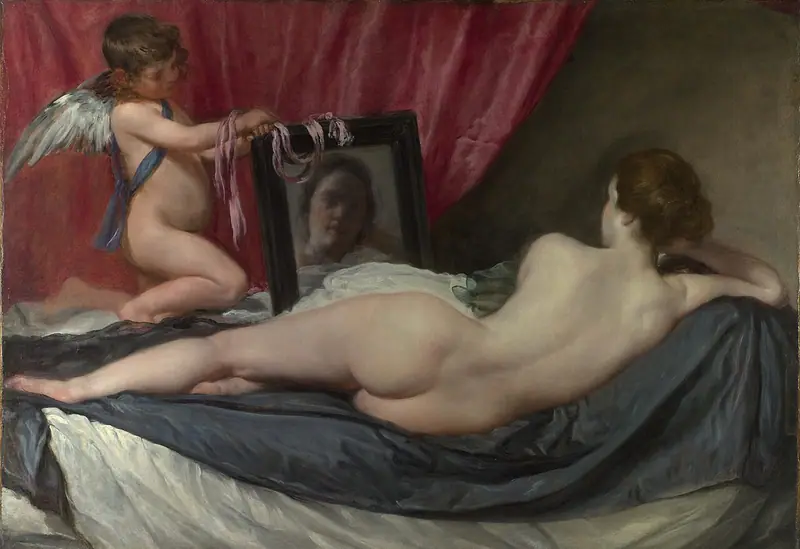
Tip: move over the painting to use the lens.
Rokeby Venus
Diego Velázquez · 1644
Venus's gaze captivates, but who's the real star of this Baroque beauty?
- Artist
- Diego Velázquez
- Date
- 1644
- Where to see it
- National Gallery
National Gallery · Public domain · image via Wikimedia Commons · see it at the museum ↗
Updated 13 October 2026 · how we write
The story
Diego Velázquez, the master of Spanish Golden Age art, crafted this masterpiece between 1647 and 1651. Rokeby Venus is a sensual, dreamlike scene where Venus, the goddess of love, lies on a bed, gazing into a mirror held by her son Cupid. The National Gallery in London is home to this stunning work.
The painting's intricate details, from the delicate folds of Venus's drapery to the soft curves of Cupid's wings, showcase Velázquez's exceptional skill as an artist.
Our perspective
Our own reading of the picture - an opinion, not a fact.
Standing in front of Rokeby Venus, I'm struck by the intimacy of the scene. It's as if I've stumbled upon a private moment, a secret shared between mother and son. This painting invites me to slow down and contemplate the complexities of love.
As I gaze at Venus's reflection, I'm reminded of the way social media often presents a curated version of reality. This painting asks me to question what's real and what's just a reflection – of myself and others.
Slow Look
- Venus's back Notice the subtle curves and contours of her back, the way the light dances across her skin.
- Cupid's wings Take a closer look at the delicate feathers and the way they seem to flutter, as if they might lift off at any moment.
- Venus's hair Marvel at the way her tresses flow down her back, like a river of gold.
- The bed Notice the softness of the bed, the way it seems to cradle Venus's form, and the subtle folds of the sheets.
About Diego Velázquez
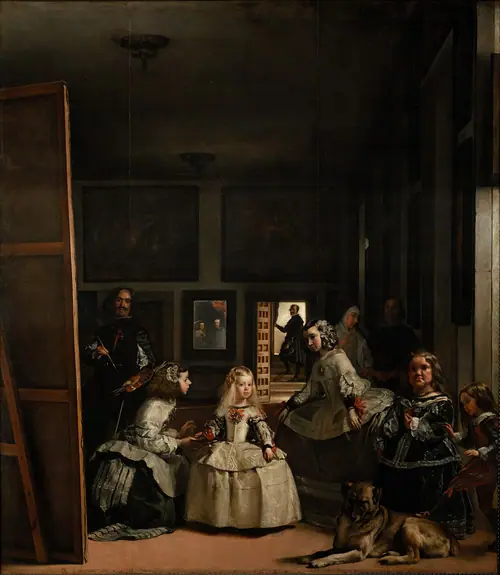
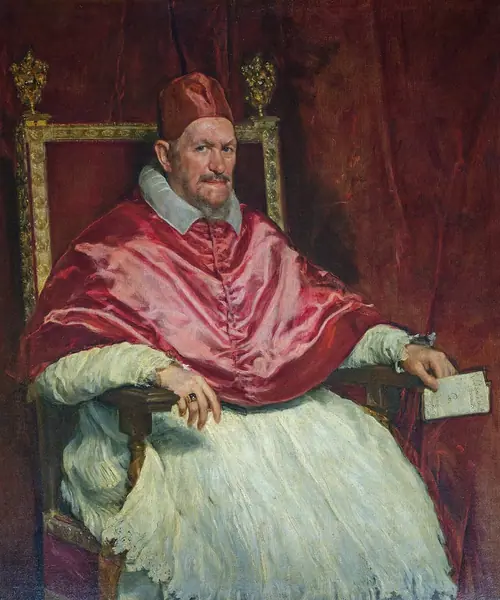
Diego Velazquez (1599-1660) was born in Seville and became court painter to King Philip IV of Spain in 1623, a post he held for the rest of his life. He painted the royal family, courtiers and ordinary people with the same direct, loose brushwork. On a trip to Rome he painted a celebrated portrait of Pope Innocent X (1650). His Las Meninas (1656), now in the Prado, is one of the most studied paintings in the world. Edouard Manet later called him the painter of painters.
Questions about Rokeby Venus
What should I know about Rokeby Venus?
Diego Velázquez, the master of Spanish Golden Age art, crafted this masterpiece between 1647 and 1651. Rokeby Venus is a sensual, dreamlike scene where Venus, the goddess of love, lies on a bed, gazing into a mirror held by her son Cupid. The National Gallery in London is home to this stunning work.
Who is the artist of Rokeby Venus?
Diego Velázquez painted Rokeby Venus.
When did Diego Velázquez make Rokeby Venus?
Diego Velázquez's Rokeby Venus is dated 1644 in the museum record.
Where can I see Rokeby Venus?
It is in the collection of National Gallery.
What is the significance of Cupid's wings in Rokeby Venus?
Cupid's wings are delicate and seem to flutter, adding to the dreamlike atmosphere.
What is the place where Rokeby Venus is housed?
The National Gallery in London is home to Rokeby Venus.
Keep reading
- Las Meninas Diego VelázquezAlso by Diego Velázquez
- The Fighting Temeraire J. M. W. TurnerAlso at National Gallery
- The Hay Wain John ConstableAlso at National Gallery
What do you see?
Stand in front of it for a moment. Then tell us what you noticed or felt - there are no wrong answers.
Be the first to share a thought.
More by Diego Velázquez

If you like this, stand in front of these