Inside the Canvas
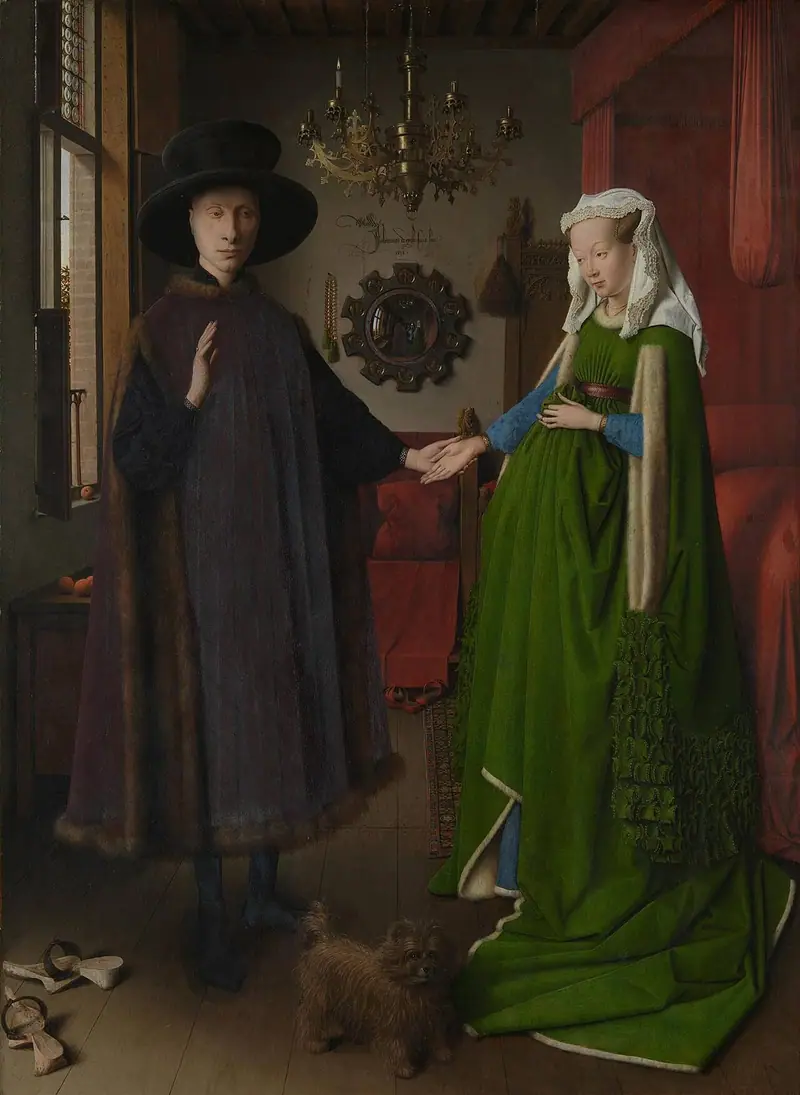
Tip: move over the painting to use the lens.
Arnolfini Portrait
Jan van Eyck · 1434
Who is the woman behind the mirror?
- Artist
- Jan van Eyck
- Date
- 1434
- Where to see it
- National Gallery
National Gallery · Public domain · image via Wikimedia Commons · see it at the museum ↗
Updated 13 October 2026 · how we write
The story
It is a masterpiece of early Netherlandish painting, showcasing the artist's innovative use of oil paint and attention to detail.
Our perspective
Our own reading of the picture - an opinion, not a fact.
As you stand in front of the painting, you can't help but feel like you're eavesdropping on a private moment. It's as if you've stumbled upon a couple's morning routine, with the wife adjusting her dress and the husband reading a letter.
The painting asks us to consider the quiet intimacy of everyday life, and how it can be a sanctuary from the world's noise.
Slow Look
- The woman's hands Notice how her hands are subtly holding the folds of her dress, a gesture of modesty and restraint.
- The mirror's frame See how the mirror's ornate frame reflects the opulence of the room, and the couple's wealth.
- The husband's letter Notice the way the husband's eyes are focused on the letter, and how it seems to hold his attention.
- The cat Look at the cat sitting on the floor, seemingly oblivious to the couple's presence.
- The woman's gaze Notice how the woman's gaze is directed inward, as if she's lost in thought.
About Jan van Eyck
Jan van Eyck was an early Netherlandish painter active in Bruges who was one of the early innovators of what became known as early Netherlandish painting, and one of the supreme figures of the Early Northern Renaissance. Such was his legacy, that he has been called "the inventor of oil-painting" by Vasari, Ernst Gombrich, and others, although this claim is now considered an oversimplification.
Text adapted from Wikipedia, Jan van Eyck, licensed CC BY-SA 4.0.
Keep reading
- Beata Beatrix Dante Gabriel RossettiShared themes: contemplative
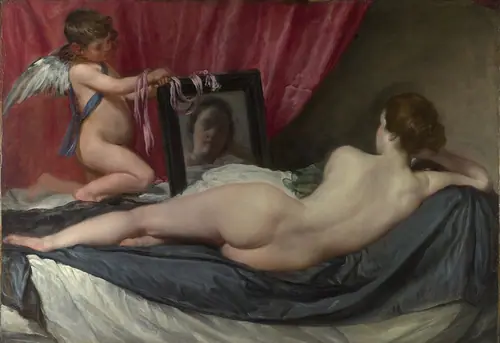
- Rokeby Venus Diego VelázquezAlso at National Gallery
- The Fighting Temeraire J. M. W. TurnerAlso at National Gallery
What do you see?
Stand in front of it for a moment. Then tell us what you noticed or felt - there are no wrong answers.
Be the first to share a thought.
More by Jan van Eyck
If you like this, stand in front of these