Tip: move over the painting to use the lens.
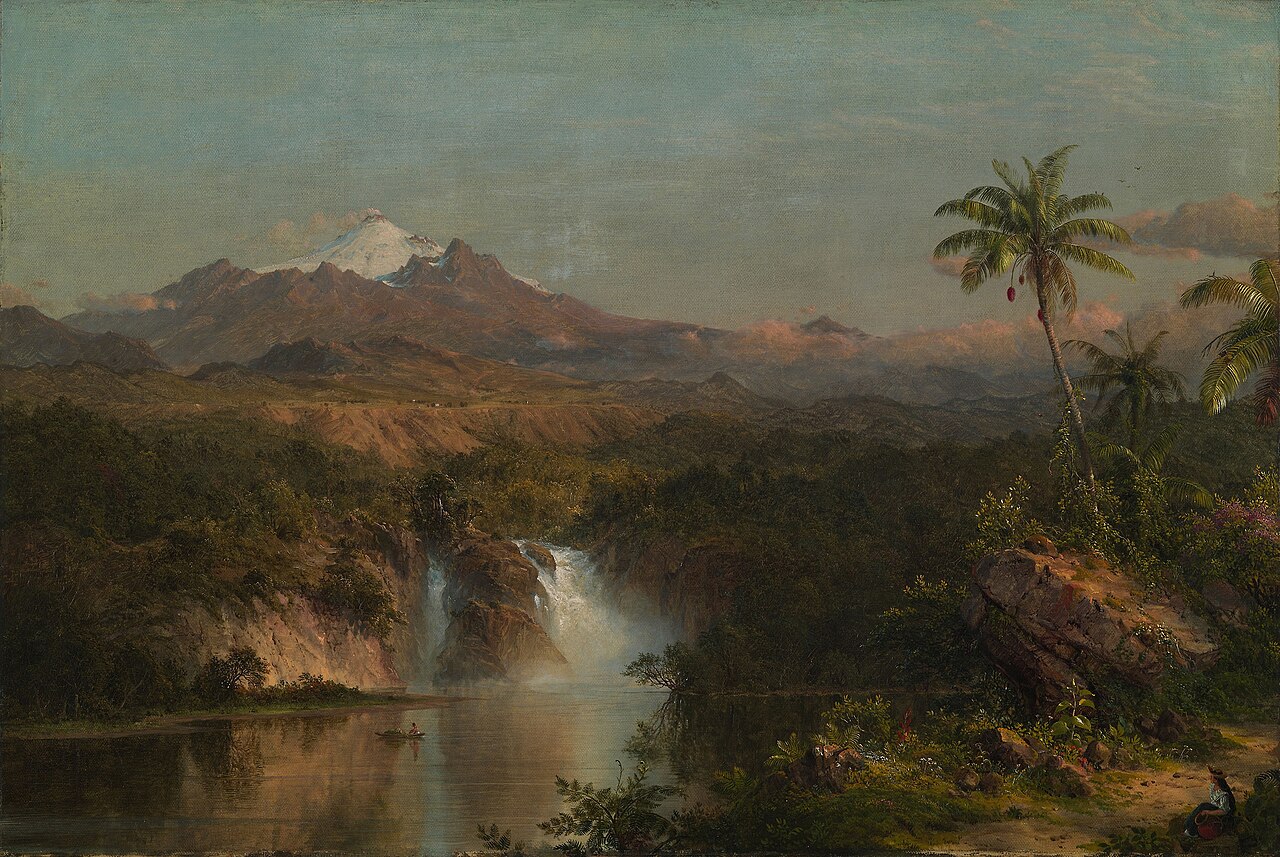
View of Cotopaxi
Frederic Edwin Church · 1857
- Artist
- Frederic Edwin Church (American, 1826–1900)
- Date
- 1857
- Medium
- Oil on canvas
- Size
- 62.2 × 92.7 cm (24 1/2 × 36 1/2 in.)
- Made in
- United States
- Style
- 19th century
- Where to see it
- Art Institute of Chicago
Gift of Jennette Hamlin in memory of Mr. and Mrs. Louis Dana Webster · CC0 Public Domain · Art Institute of Chicago · image via Wikimedia Commons · see it at the museum ↗
Notes from the museum
View of Cotopaxi brings together in visual form scientific, religious, political, and cultural ideas in the mid-19th century. Inspired by German naturalist Alexander von Humboldt’s concept of ecological interconnectedness, Frederic Edwin Church traveled to South America to meticulously study the tropical landscape. The artist produced at least ten finished paintings of the Ecuadorian volcano, this one completed in his studio just before his second visit to the region. For Church and other Christian viewers, nature, with all its creative and destructive wonders, was evidence of divine power. The painting likewise reflected an imperialist vision, as US government officials eyed Latin America as a site for territorial expansion and conquest.
Text: Art Institute of Chicago (open access). Our full story for this work is coming soon.
Slow Look
- The whole picture Let your eyes wander. Where do they want to rest?
- The light Find the brightest spot. What is it showing you?
- The edges Look at what is half cut off at the borders.
- One small detail Choose one tiny thing and stay with it for a while.
- The whole picture again Step back. Has it changed for you?
About Frederic Edwin Church
Frederic Edwin Church was an American landscape painter born in Hartford, Connecticut. He was a central figure in the Hudson River School of American landscape painters, best known for painting large landscapes, often depicting mountains, waterfalls, and sunsets. Church's paintings put an emphasis on realistic detail, dramatic light, and panoramic views. He debuted some of his major works in single-painting exhibitions to a paying and often enthralled audience in New York City. In his prime, he was one of the most famous painters in the United States.
What do you see?
Stand in front of it for a moment. Then tell us what you noticed or felt - there are no wrong answers.
Be the first to share a thought.
If you like this, stand in front of these