Inside the Canvas
Tip: move over the painting to use the lens.
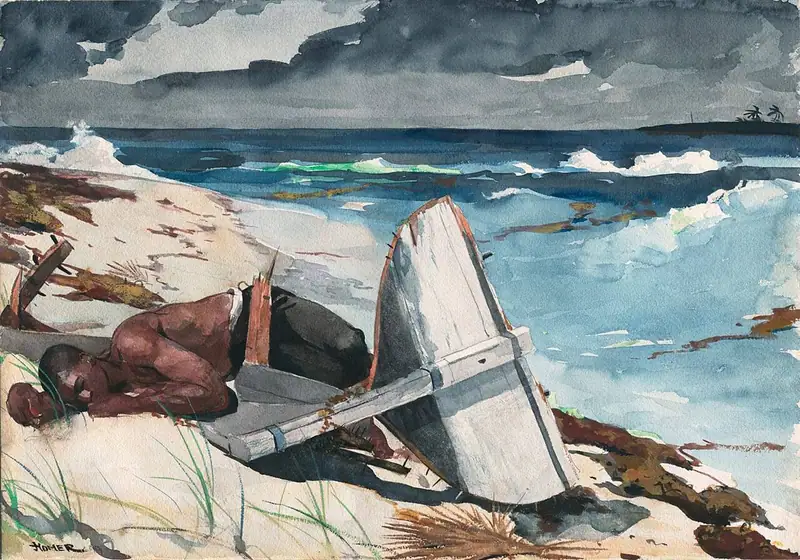
After the Hurricane, Bahamas
Winslow Homer · 1899
Is this man's luck about to change?
- Artist
- Winslow Homer American, 1836-1910
- Date
- 1899
- Medium
- Transparent watercolor, with touches of opaque watercolor, rewetting, blotting and scraping, over graphite, on moderately thick, moderately textured (twill texture on verso), ivory wove paper
- Size
- 37.2 × 54.2 cm (14 11/16 × 21 3/8 in.)
- Made in
- United States
- Where to see it
- Art Institute of Chicago
Mr. and Mrs. Martin A. Ryerson Collection · CC0 Public Domain · Art Institute of Chicago · image via Wikimedia Commons · see it at the museum ↗
Updated 20 October 2026 · how we write
The story
Painted in 1899, this watercolor depicts a man washed up on the beach in the Bahamas after a hurricane.
The Bahamas were a new location for Homer, who was drawn to the region's rapid and dangerous weather changes.
Our perspective
Our own reading of the picture - an opinion, not a fact.
As you stand in front of this painting, you can't help but feel a sense of empathy for the man, battered and worn from the storm.
This work asks us to consider the fragility of human existence and the power of nature.
You might find yourself wondering what the man's story is, and what his journey was like before the storm.
It's a reminder that even in the midst of turmoil, there is always hope for a new beginning.
This painting invites us to slow down and appreciate the beauty in the everyday, even in the midst of chaos.
Slow Look
- the man's face Notice the subtle expression of resignation on the man's face, a sign of his acceptance of his situation.
- the seaweed Look at the thickly applied opaque red and yellow pigments used to render the seaweed tossed on the sand.
- the waves Notice the fluid brushstrokes used to render the receding waves, creating a sense of movement and energy.
- the clouds Look at the gradually thinning storm clouds, a sign of the storm's passing.
- the sand Notice the texture of the sand, a reminder of the fragile balance between the natural and human worlds.
About Winslow Homer
Winslow Homer (1836-1910) was an American painter who began his career as a magazine illustrator before turning to painting. From the 1880s he lived at Prouts Neck on the coast of Maine, where he painted the sea in all its moods, with crashing waves and rocky shores. He was also a brilliant watercolourist, recording fishing trips in the Adirondacks and bright scenes in the Bahamas and the Caribbean. His seascapes, such as The Gulf Stream (1899), made him one of the most admired American artists of his time.
Questions about After the Hurricane, Bahamas
What is the story behind After the Hurricane, Bahamas?
Painted in 1899, this watercolor depicts a man washed up on the beach in the Bahamas after a hurricane.
Who made After the Hurricane, Bahamas?
Winslow Homer made After the Hurricane, Bahamas.
When was After the Hurricane, Bahamas made?
The museum record dates After the Hurricane, Bahamas to 1899.
Where is After the Hurricane, Bahamas today?
You can see it at Art Institute of Chicago, which holds it in its collection.
What is After the Hurricane, Bahamas made with?
Its medium is transparent watercolor, with touches of opaque watercolor, rewetting, blotting and scraping, over graphite, on moderately thick, moderately textured (twill texture on verso), ivory wove paper.
What is the size of the painting 'After the Hurricane, Bahamas' by Winslow Homer?
The painting measures 37.2 × 54.2 cm (14 11/16 × 21 3/8 in.).
Keep reading
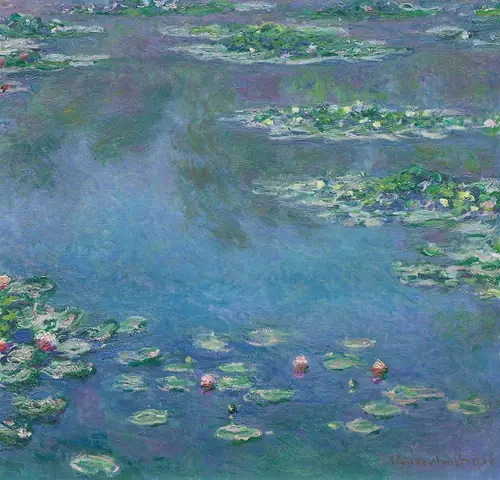
- Water Lilies Claude MonetAlso at Art Institute of Chicago
- Beata Beatrix Dante Gabriel RossettiAlso at Art Institute of Chicago
- A Sunday Afternoon on the Island of La Grande Jatte Georges SeuratAlso at Art Institute of Chicago
What do you see?
Stand in front of it for a moment. Then tell us what you noticed or felt - there are no wrong answers.
Be the first to share a thought.
More by Winslow Homer
If you like this, stand in front of these