Inside the Canvas
Tip: move over the painting to use the lens.
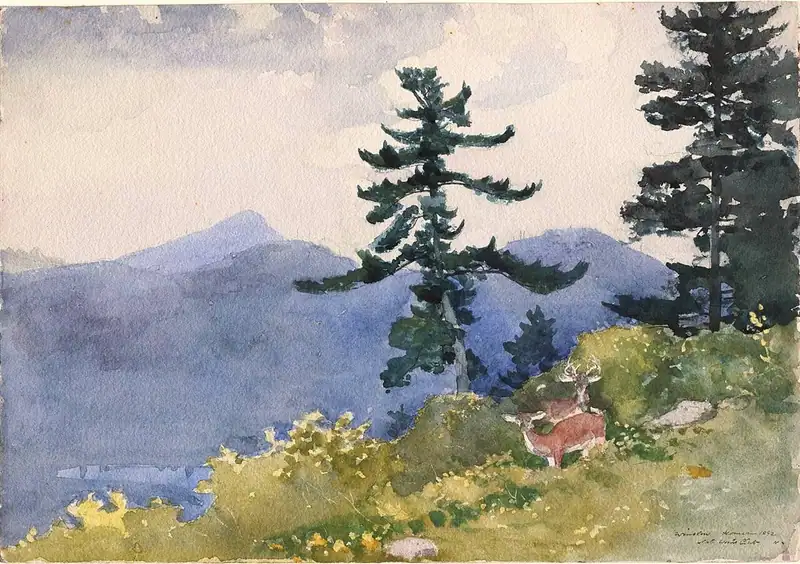
North Woods Club, Adirondacks (The Interrupted Tete-a-Tete)
Winslow Homer · 1892
- Artist
- Winslow Homer American, 1836-1910
- Date
- 1892
- Medium
- Watercolor, with rewetting, blotting and scraping, over graphite, on thick, moderately textured, ivory wove paper
- Size
- 38 × 54.5 cm (15 × 21 1/2 in.)
- Made in
- United States
- Where to see it
- Art Institute of Chicago
Mr. and Mrs. Martin A. Ryerson Collection · CC0 Public Domain · Art Institute of Chicago · image via Wikimedia Commons · see it at the museum ↗
Updated 13 October 2026 · how we write
Notes from the museum
In numerous watercolors, Homer explored aspects of the controversy over deer hunting practices in the Adirondack region without overtly expressing his own opinion. In North Woods Club, Adirondacks (The Interrupted Tête-à-tête) , hunting is only hinted at in a subliminal way. Homer pictured two white-tailed deer, a doe and a buck, at the edge of a mountain meadow. Homer selected the exact moment when the deer become aware of another presence, the identity of whom is left to the viewer’s imagination. He juxtaposed a yellow-green flowering meadow with cool, purple-blue mountains, creating an entrancing summer vista. Yet Homer alluded to a less-benign narrative that would have been clear to his contemporaries. Two tall white pines stand silhouetted against the view, echoing the two deer. White pine had been dangerously over harvested in this period, and worry over its dwindling numbers in the Adirondacks paralleled concern for excessive hunting of deer. Homer drew the pine trees and deer carefully in pencil before adding watercolor, making sure that the distinctive characteristics of both threatened species would be clearly identifiable.
Text: Art Institute of Chicago (open access). Our full story for this work is coming soon.
Slow Look
- The whole picture Let your eyes wander. Where do they want to rest?
- The light Find the brightest spot. What is it showing you?
- The edges Look at what is half cut off at the borders.
- One small detail Choose one tiny thing and stay with it for a while.
- The whole picture again Step back. Has it changed for you?
About Winslow Homer
Winslow Homer (1836-1910) was an American painter who began his career as a magazine illustrator before turning to painting. From the 1880s he lived at Prouts Neck on the coast of Maine, where he painted the sea in all its moods, with crashing waves and rocky shores. He was also a brilliant watercolourist, recording fishing trips in the Adirondacks and bright scenes in the Bahamas and the Caribbean. His seascapes, such as The Gulf Stream (1899), made him one of the most admired American artists of his time.
Keep reading
- After the Hurricane, Bahamas Winslow HomerAlso by Winslow Homer
- Water Lilies Claude MonetAlso at Art Institute of Chicago
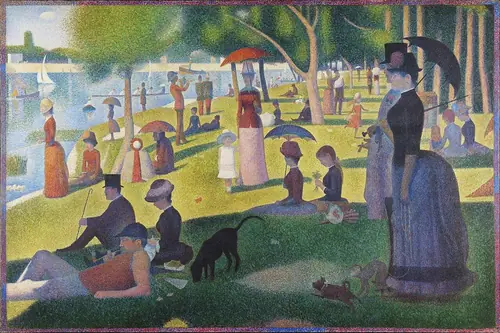
- A Sunday Afternoon on the Island of La Grande Jatte Georges SeuratAlso at Art Institute of Chicago
What do you see?
Stand in front of it for a moment. Then tell us what you noticed or felt - there are no wrong answers.
Be the first to share a thought.
More by Winslow Homer
If you like this, stand in front of these