Inside the Canvas
Tip: move over the painting to use the lens.
The Combat of the Giaour and Hassan
Eugène Delacroix · 1826
Is violence a necessary act of love?
- Artist
- Eugène Delacroix (French, 1798–1863)
- Date
- 1826
- Medium
- Oil on canvas
- Size
- 59.6 × 73.4 cm (23 1/2 × 28 7/8 in.); Framed: 87.4 × 101.3 cm (34 3/8 × 39 7/8 in.)
- Made in
- France
- Style
- 19th century
- Where to see it
- Art Institute of Chicago
Gift of Bertha Palmer Thorne, Rose Movius Palmer, Mr. and Mrs. Arthur M. Wood, and Mr. and Mrs. Gordon Palmer · CC0 Public Domain · Art Institute of Chicago · image via Wikimedia Commons · see it at the museum ↗
Updated 30 October 2026 · how we write
The story
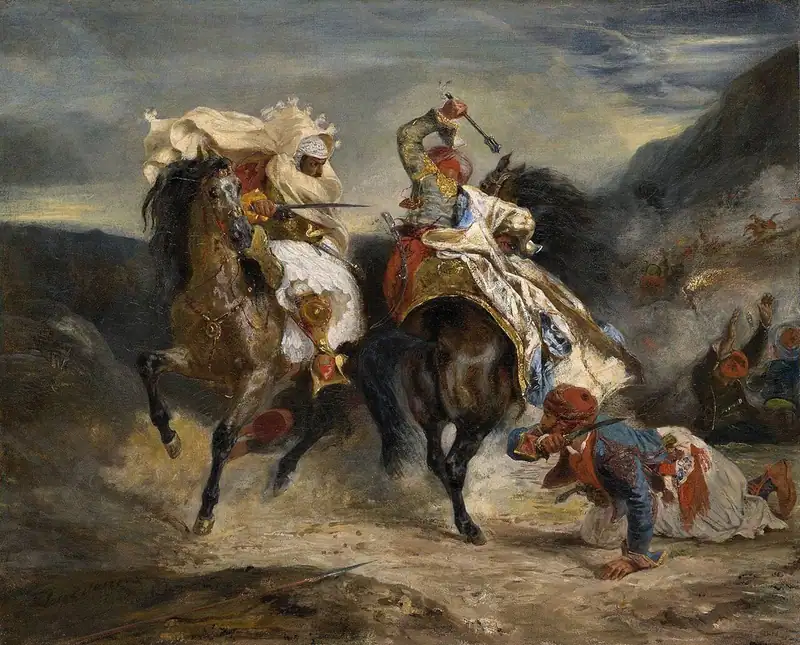
French Romantic artist Eugène Delacroix created 'The Combat of the Giaour and Hassan' in 1826. The painting depicts a violent struggle between the Giaour and Hassan, inspired by Lord Byron's poem.
Delacroix's use of shimmering primary hues and loose paint handling creates a sense of dynamism, reflecting the artist's mastery of color. The painting is a prime example of Orientalism, a popular artistic movement in the 19th century.
This work reflects Delacroix's sustained engagement with Orientalism, which was often used to reinforce French colonial enterprises through fantastical, violent, or erotic depictions of non-European cultures.
Our perspective
Our own reading of the picture - an opinion, not a fact.
As you stand in front of 'The Combat of the Giaour and Hassan', you can't help but feel the intensity of the violent struggle. It's as if the horses are about to gallop off the canvas, pulling the warriors with them.
The painting asks us to consider whether violence is ever a necessary act of love. Can we justify the Giaour's brutal revenge as an act of passion?
The artwork also makes us think about the power of art to reflect and shape our understanding of the world. Delacroix's use of vibrant colors and dynamic composition draws us in, inviting us to explore the themes and emotions depicted.
Slow Look
- the swirling white drapery Notice the intricate folds and textures of the Giaour's clothing, which seem to ripple and move like a living thing.
- the horses' manes Pay attention to the way the horses' manes seem to flow and blend with the surrounding clouds, creating a sense of continuity between the natural and supernatural worlds.
- the faces of the warriors Take a closer look at the faces of the Giaour and Hassan, which seem to be frozen in a moment of intense emotion. What do their expressions reveal about their motivations and personalities?
- the cloudy background Notice how the cloudy background seems to swirl and churn, mirroring the violence and intensity of the foreground. This creates a sense of tension and energy that pulls the viewer's eye back and forth between the different elements of the composition.
- the Giaour's sword Look closely at the Giaour's sword, which seems to be poised for the fatal blow. What does this symbolize about the Giaour's character and motivations?
About Eugène Delacroix
Ferdinand Victor Eugène Delacroix was a French Romantic artist who was regarded as the leader of the French Romantic school.
Text adapted from Wikipedia, Eugène Delacroix, licensed CC BY-SA 4.0.
Questions about The Combat of the Giaour and Hassan
What is known about The Combat of the Giaour and Hassan by Eugène Delacroix?
French Romantic artist Eugène Delacroix created 'The Combat of the Giaour and Hassan' in 1826. The painting depicts a violent struggle between the Giaour and Hassan, inspired by Lord Byron's poem.
Which artist painted The Combat of the Giaour and Hassan?
Eugène Delacroix painted The Combat of the Giaour and Hassan.
What is the date of The Combat of the Giaour and Hassan?
The Combat of the Giaour and Hassan is dated 1826.
Where can I see The Combat of the Giaour and Hassan?
The Combat of the Giaour and Hassan is held by Art Institute of Chicago.
What technique did Eugène Delacroix use for The Combat of the Giaour and Hassan?
Its medium is oil on canvas.
What style is The Combat of the Giaour and Hassan?
It is listed under 19th century.
What is the inspiration behind the painting combat of the giaour and hassan?
Eugène Delacroix took inspiration from Lord Byron's poem 'The Giaour'.
What is the significance of the swirling white drapery in The Combat of the Giaour and Hassan?
The swirling white drapery represents the Giaour's clothing, which seems to ripple and move like a living thing.
Keep reading
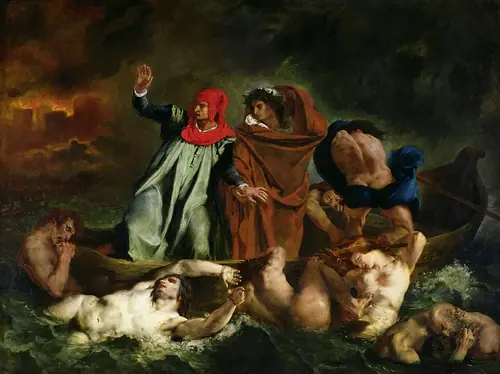
- The Barque of Dante Eugène DelacroixAlso by Eugène Delacroix
- The Races at Longchamp Édouard ManetAlso at Art Institute of Chicago
- Water Lilies Claude MonetAlso at Art Institute of Chicago
What do you see?
Stand in front of it for a moment. Then tell us what you noticed or felt - there are no wrong answers.
Be the first to share a thought.
More by Eugène Delacroix
If you like this, stand in front of these