Inside the Canvas
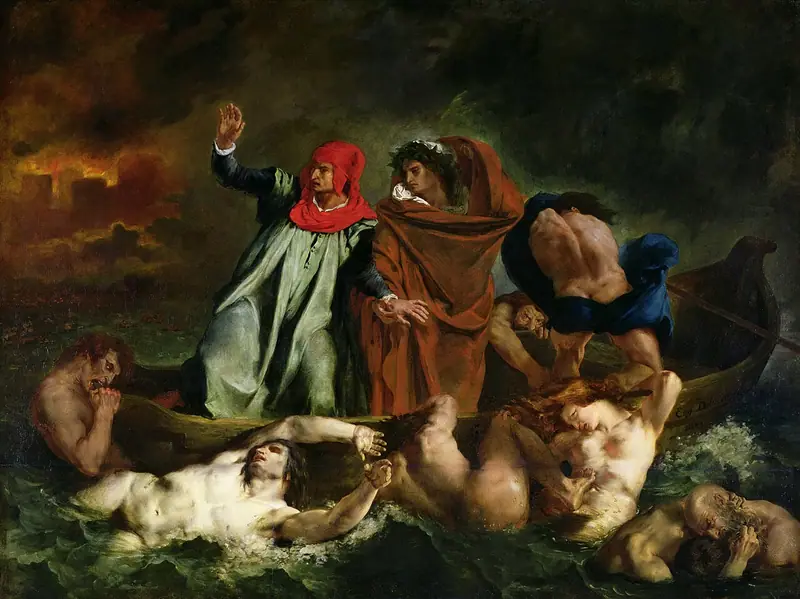
Tip: move over the painting to use the lens.
The Barque of Dante
Eugène Delacroix · 1822
What secrets lie hidden in the river's depths?
- Artist
- Eugène Delacroix
- Date
- 1822
- Where to see it
- Louvre
Louvre · Public domain · image via Wikimedia Commons · see it at the museum ↗
Updated 18 October 2026 · how we write
The story
Delacroix's 1822 masterpiece, The Barque of Dante, transports viewers to a mystical realm. The painting is an oil-on-canvas depiction of Dante and his guide Virgil navigating the treacherous waters of the river Styx. Based on Canto VIII of Dante's Inferno, the scene is alive with drama and tension.
The Louvre's collection boasts this striking work, a testament to Delacroix's skill in capturing the essence of the Romantic era. His bold brushstrokes and vivid colors bring the world of ancient mythology to life.
The Louvre's The Barque of Dante is an iconic work that showcases Delacroix's mastery of oil painting. The artist's use of chiaroscuro and vivid color palette creates a sense of urgency and foreboding.
This 1822 painting is a celebration of Delacroix's artistic prowess. His use of bold colors and dynamic composition creates a captivating scene that draws the viewer in.
This oil painting, created in 1822, is a masterpiece of the Romantic era. Delacroix's depiction of the river Styx and the boat of Phlegyas is a testament to his skill and creativity.
Our perspective
Our own reading of the picture - an opinion, not a fact.
As you stand before The Barque of Dante, you can't help but feel the weight of the unknown. The darkness of the river Styx seems to press in on the figures, threatening to consume them. It's as if the painting is asking you to step into the unknown, to leave your worries behind and embark on a journey of self-discovery.
The Barque of Dante is a reminder that even in the darkest of times, there is always hope. The bond between Dante and Virgil is a testament to the power of human connection and the importance of having a guiding light in our lives.
This painting is a call to action. It asks you to take a leap of faith, to trust in the unknown and to have the courage to explore the depths of your own soul.
This 1822 masterpiece is a reflection of our own journeys, our own struggles and triumphs. It's a reminder that we are not alone, that we are all on this journey together, and that the power to overcome our challenges lies within us.
Slow Look
- The figures on the boat Notice the tension in the bodies of Dante and Virgil as they navigate the treacherous waters.
- The river Styx Take in the dark, mysterious depths of the river, symbolizing the unknown.
- The damned souls Notice the desperation and despair etched on the faces of the damned souls clinging to the boat.
- Phlegyas' boat Take in the eerie, otherworldly atmosphere of the boat, a vessel of the dead.
- The colors Notice the bold, vibrant colors used by Delacroix to bring the scene to life, adding depth and emotion to the painting.
About Eugène Delacroix
Ferdinand Victor Eugène Delacroix was a French Romantic artist who was regarded as the leader of the French Romantic school.
Text adapted from Wikipedia, Eugène Delacroix, licensed CC BY-SA 4.0.
Questions about The Barque of Dante
What is the story behind The Barque of Dante?
Delacroix's 1822 masterpiece, The Barque of Dante, transports viewers to a mystical realm. The painting is an oil-on-canvas depiction of Dante and his guide Virgil navigating the treacherous waters of the river Styx. Based on Canto VIII of Dante's Inferno, the scene is alive with drama and tension.
Who is the artist of The Barque of Dante?
The Barque of Dante was painted by Eugène Delacroix.
What is the date of The Barque of Dante?
The museum record dates The Barque of Dante to 1822.
Where can I see The Barque of Dante?
It is in the collection of Louvre.
What is the significance of the river Styx in the Barque of Dante?
The river Styx symbolizes the unknown.
Keep reading
- Mona Lisa Leonardo da VinciAlso at Louvre
- La Belle Ferronnière Leonardo da VinciAlso at Louvre
- Grande Odalisque Jean-Auguste-Dominique IngresAlso at Louvre
What do you see?
Stand in front of it for a moment. Then tell us what you noticed or felt - there are no wrong answers.
Be the first to share a thought.
More by Eugène Delacroix

If you like this, stand in front of these