Inside the Canvas
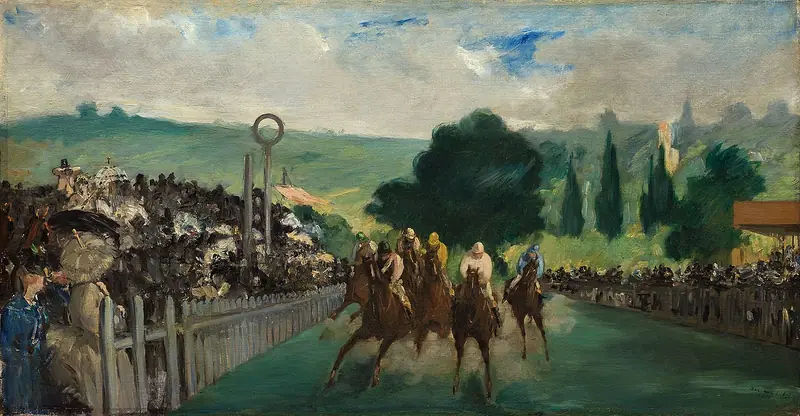
Tip: move over the painting to use the lens.
The Races at Longchamp
Édouard Manet · 1866
What's the thrill in witnessing history's pace?
- Artist
- Édouard Manet (French, 1832–1883)
- Date
- 1866
- Medium
- Oil on canvas
- Size
- 44 × 84.2 cm (17 5/16 × 33 1/8 in.); Framed: 69.6 × 109.9 × 10.2 cm (27 3/8 × 43 1/4 × 4 in.)
- Made in
- France
- Style
- Impressionism
- Where to see it
- Art Institute of Chicago
Potter Palmer Collection · CC0 Public Domain · Art Institute of Chicago · image via Wikimedia Commons · see it at the museum ↗
Updated 29 October 2026 · how we write
The story
Édouard Manet's The Races at Longchamp captures the excitement of a horse race at the Bois de Boulogne in Paris.
Manet's depiction of the race is unconventional, as he shows the competitors from the front, unlike traditional representations.
The painting is a representation of modern life in France during the 19th century, with fashionably dressed men and women watching the event.
Our perspective
Our own reading of the picture - an opinion, not a fact.
The first thing that strikes you is the energy of the horses as they thunder towards you, their hooves pounding the ground.
The painting asks us to consider the thrill of witnessing something historic unfolding before our eyes.
It's like standing at the edge of a sports stadium, feeling the rush of adrenaline as the athletes give it their all.
Slow Look
- The horses' eyes Take in the intensity and focus of the horses as they give their all.
- The racetrack's shape Notice how the diagonal lines of the track add to the sense of movement and energy.
- The fashionably dressed onlookers Feel the excitement and anticipation of the crowd as they cheer on their favorite horses.
- The cloud of turf See how the cloud of turf and the horses' hooves create a sense of depth and dimension.
- Manet's brushstrokes Notice the bold, expressive brushstrokes that give the painting its sense of dynamism and energy.
About Édouard Manet
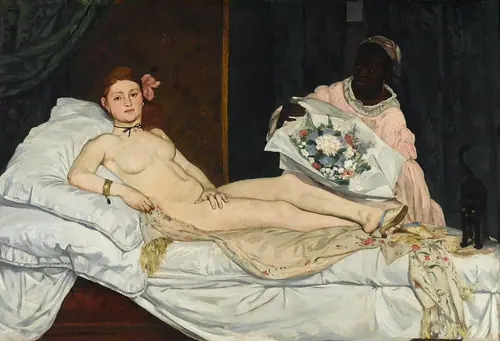
Edouard Manet (1832-1883) was a Paris painter who chose modern city life as his subject. His Le Dejeuner sur l'herbe caused a stir at the 1863 Salon des Refuses, and Olympia caused another in 1865. He was a friend of Monet, Degas and the younger Impressionists, but he never showed at their group exhibitions and kept sending work to the official Salon. His loose, flat way of painting bridged Realism and Impressionism. A Bar at the Folies-Bergere (1882) was his last major painting.
Questions about The Races at Longchamp
What should I know about The Races at Longchamp?
Édouard Manet's The Races at Longchamp captures the excitement of a horse race at the Bois de Boulogne in Paris.
Who is the artist of The Races at Longchamp?
The Races at Longchamp was painted by Édouard Manet.
What is the date of The Races at Longchamp?
The Races at Longchamp is dated 1866.
Which museum has The Races at Longchamp?
The Races at Longchamp is held by Art Institute of Chicago.
What medium is The Races at Longchamp?
The museum lists the medium as oil on canvas.
Which art movement does The Races at Longchamp belong to?
The style recorded for The Races at Longchamp is Impressionism.
Why is the painting 'the races at longchamp' by édouard manet considered unconventional?
The Races at Longchamp is considered unconventional because Manet shows the competitors from the front, unlike traditional representations.
What style is The Races at Longchamp by Édouard Manet?
The style of The Races at Longchamp by Édouard Manet is Impressionism.
Keep reading
- The Beach at Sainte-Adresse Claude MonetAlso Impressionism
- Paris Street; Rainy Day Gustave CaillebotteAlso Impressionism
- Water Lilies Claude MonetAlso Impressionism
What do you see?
Stand in front of it for a moment. Then tell us what you noticed or felt - there are no wrong answers.
Be the first to share a thought.
More by Édouard Manet
If you like this, stand in front of these