Tip: move over the painting to use the lens.
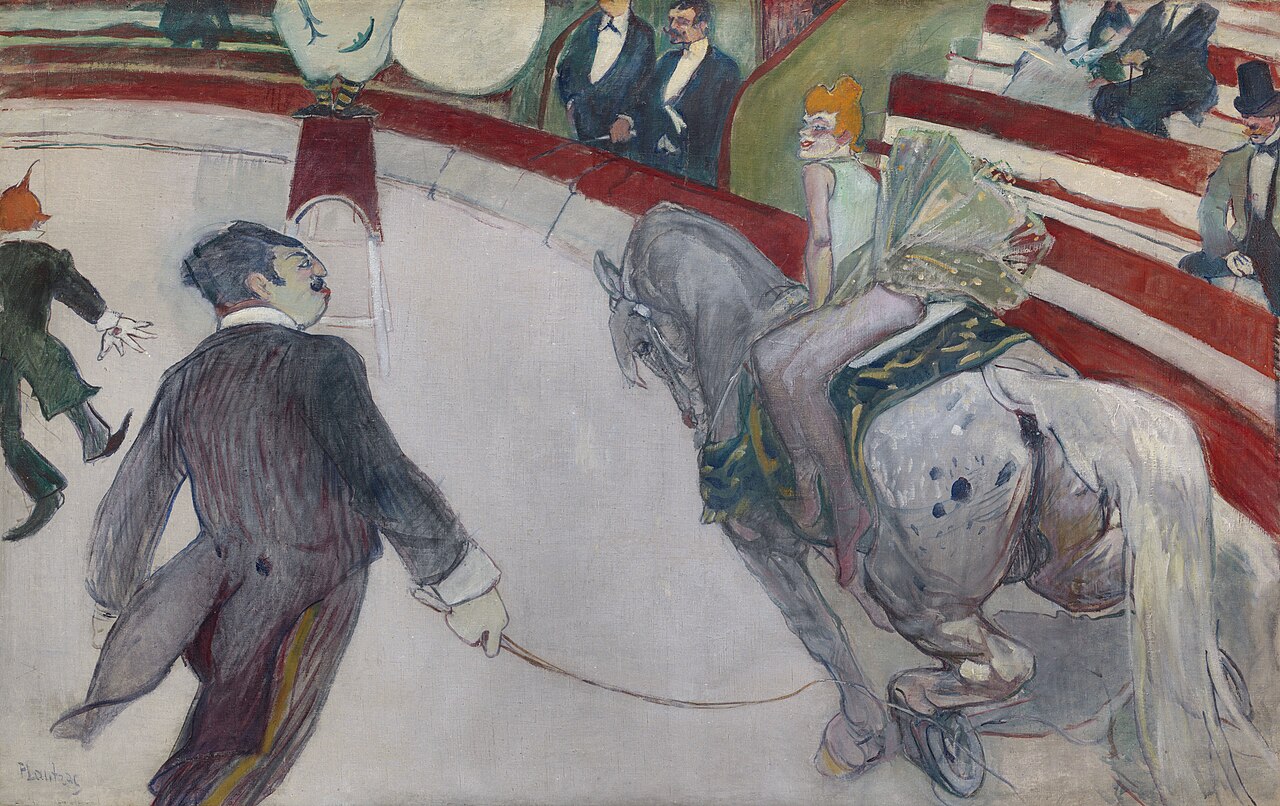
Equestrienne (At the Cirque Fernando)
Henri de Toulouse-Lautrec · 1887–88
- Artist
- Henri de Toulouse-Lautrec (French, 1864–1901)
- Date
- 1887–88
- Medium
- Oil on canvas
- Size
- 100.3 × 161.3 cm (39 1/2 × 63 1/2 in.); Framed: 123.2 × 181 × 8.3 cm (48 1/2 × 71 1/4 × 3 1/4 in.)
- Made in
- France
- Style
- Post-Impressionism
- Where to see it
- Art Institute of Chicago
Joseph Winterbotham Collection · CC0 Public Domain · Art Institute of Chicago · image via Wikimedia Commons · see it at the museum ↗
Notes from the museum
This work, set at a circus, captures the tense moment in which a female trick rider prepares to stand up on her horse and leap through a paper hoop held by a clown. The horse gathers speed, spurred on by the whip of famous ringmaster Monsieur Loyal. Henri de Toulouse-Lautrec may have based the garishly made-up rider, dressed in a tutu of gauze and sequins, on Suzanne Valadon, a former circus performer, model, and artist with whom he had a nearly three-year relationship. The rider seems to snarl at Monsieur Loyal, who glares back at her. Toulouse-Lautrec’s setting is the same circus in Montmartre depicted in Pierre-Auguste Renoir’s portrait of the Wartenberg sisters . This is one of thirty-five works that comprise the Winterbotham Collection. Click here to learn more about the collection.
Text: Art Institute of Chicago (open access). Our full story for this work is coming soon.
Slow Look
- The whole picture Let your eyes wander. Where do they want to rest?
- The light Find the brightest spot. What is it showing you?
- The edges Look at what is half cut off at the borders.
- One small detail Choose one tiny thing and stay with it for a while.
- The whole picture again Step back. Has it changed for you?
About Henri de Toulouse-Lautrec
Comte Henri Marie Raymond de Toulouse-Lautrec-Montfa, known as Toulouse-Lautrec, was a French painter, printmaker, draughtsman, caricaturist, and illustrator. His immersion in the colourful and theatrical life of Paris's Belle Époque in the late 19th century allowed him to produce popular works of art from decadent affairs.
What do you see?
Stand in front of it for a moment. Then tell us what you noticed or felt - there are no wrong answers.
Be the first to share a thought.
More by Henri de Toulouse-Lautrec
If you like this, stand in front of these