Inside the Canvas
Tip: move over the painting to use the lens.
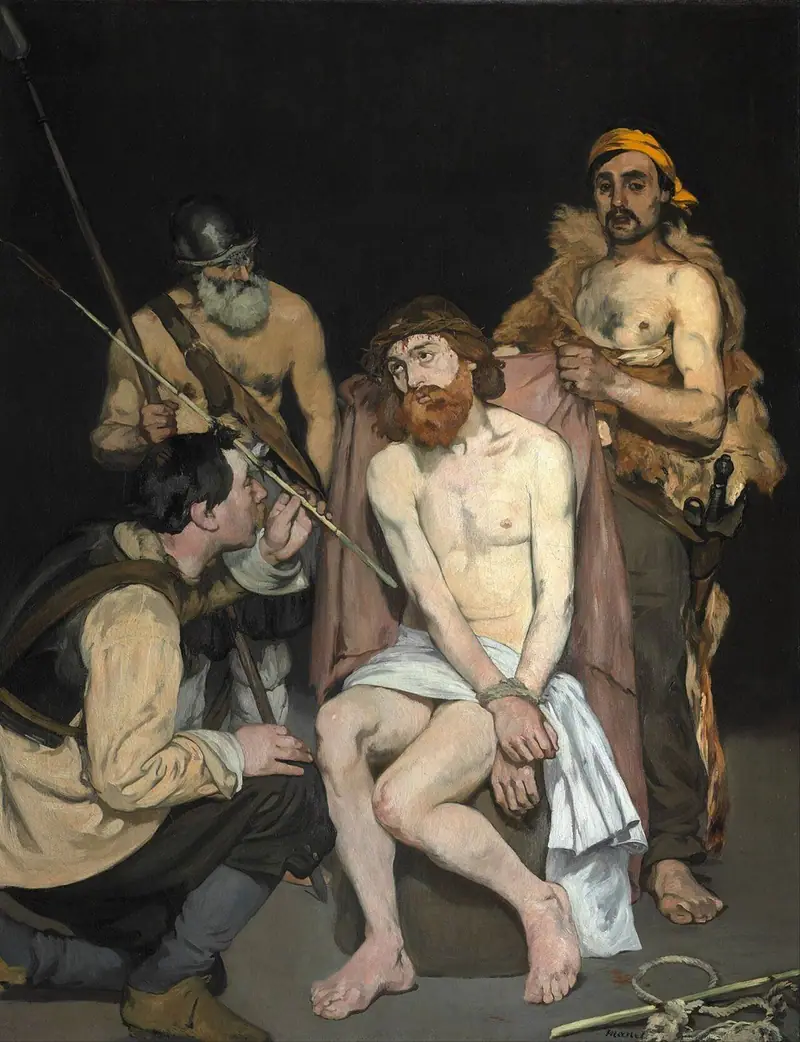
Jesus Mocked by the Soldiers
Édouard Manet · 1865
- Artist
- Édouard Manet (French, 1832–1883)
- Date
- 1865
- Medium
- Oil on canvas
- Size
- 190.8 × 148.3 cm (74 7/8 × 58 3/8 in.); Framed: 240.1 × 196.9 cm (94 1/2 × 77 1/2 in.)
- Made in
- France
- Style
- Realism
- Where to see it
- Art Institute of Chicago
Gift of James Deering · CC0 Public Domain · Art Institute of Chicago · image via Wikimedia Commons · see it at the museum ↗
Updated 13 October 2026 · how we write
Notes from the museum
Throughout his career Édouard Manet managed to shock and confound the public with his bold technique and unorthodox approach to subject matter. The most startling feature of this painting is that he painted it at all. Following the advent of the Realist movement, which grounded art in the here and now, avant-garde artists in France did not pursue religious themes. While Manet was primarily a painter of secular subjects, he was also interested in art history, which led him on at least two occasions to depict the biblical narratives that had compelled artists for many centuries. This work might also have been inspired by the popular 1863 biography Vie de Jésus (Life of Jesus) by the French philosopher and historian Joseph-Ernest Renan, a controversial work that emphasized Christ’s humanity. Here, Manet depicted Jesus at the end of his life, beaten and awaiting crucifixion. The Roman soldiers force him to don a crown of thorns and proffer a reed “scepter” and purple cloak, all intended to ridicule him as “King of the Jews,” a title bestowed ironically by his tormenters. Manet transformed this sacred narrative into a gritty drama that marries realism with theatricality. He presented Jesus frontally, emphasizing his vulnerability and human physicality. Jesus seems exhausted and limp. The canvas’s visible brushstrokes and color palette create a sense of materiality that further evokes
Text: Art Institute of Chicago (open access). Our full story for this work is coming soon.
Slow Look
- The whole picture Let your eyes wander. Where do they want to rest?
- The light Find the brightest spot. What is it showing you?
- The edges Look at what is half cut off at the borders.
- One small detail Choose one tiny thing and stay with it for a while.
- The whole picture again Step back. Has it changed for you?
About Édouard Manet
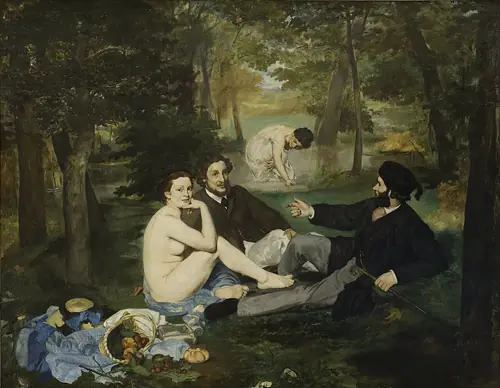
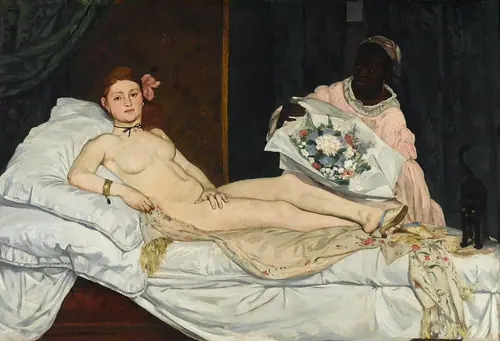
Edouard Manet (1832-1883) was a Paris painter who chose modern city life as his subject. His Le Dejeuner sur l'herbe caused a stir at the 1863 Salon des Refuses, and Olympia caused another in 1865. He was a friend of Monet, Degas and the younger Impressionists, but he never showed at their group exhibitions and kept sending work to the official Salon. His loose, flat way of painting bridged Realism and Impressionism. A Bar at the Folies-Bergere (1882) was his last major painting.
Keep reading
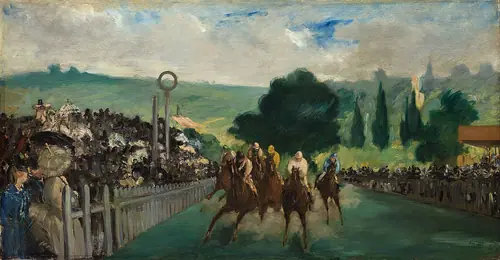
- The Races at Longchamp Édouard ManetAlso by Édouard Manet
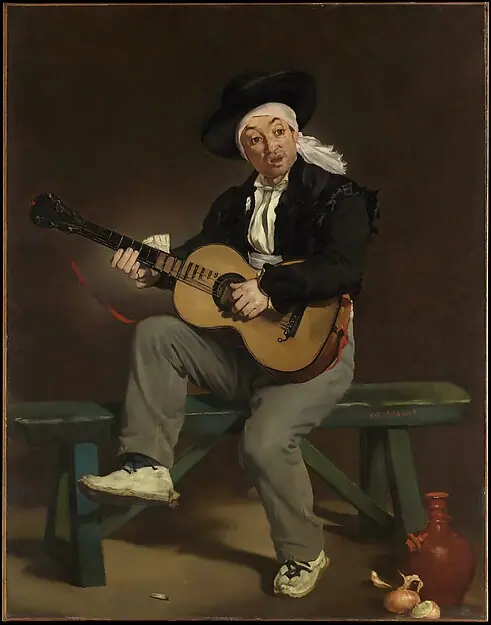
- The Spanish Singer Edouard ManetAlso by Edouard Manet
- Water Lilies Claude MonetAlso at Art Institute of Chicago
What do you see?
Stand in front of it for a moment. Then tell us what you noticed or felt - there are no wrong answers.
Be the first to share a thought.
More by Édouard Manet
If you like this, stand in front of these