Inside the Canvas
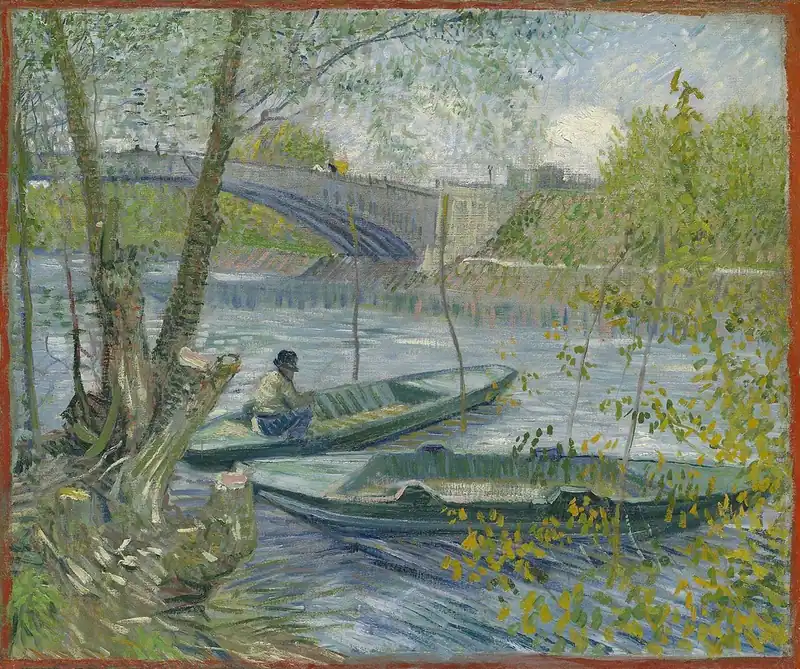
Tip: move over the painting to use the lens.
Fishing in Spring, the Pont de Clichy (Asnières)
Vincent van Gogh · 1887
- Artist
- Vincent van Gogh (Dutch, 1853–1890)
- Date
- 1887
- Medium
- Oil on canvas
- Size
- 50.5 × 60 cm (19 7/8 × 23 5/8 in.); Framed: 71.2 × 78.5 × 4.8 cm (28 × 30 7/8 × 1 7/8 in.)
- Made in
- Netherlands
- Style
- Impressionism
- Where to see it
- Art Institute of Chicago
Gift of Charles Deering McCormick, Brooks McCormick, and Roger McCormick · CC0 Public Domain · Art Institute of Chicago · image via Wikimedia Commons · see it at the museum ↗
Updated 13 October 2026 · how we write
Notes from the museum
The setting of this work is the river Seine at the Clichy Bridge near Asnières, a suburb north of Paris where Vincent van Gogh painted on several occasions with his friend and fellow artist Paul Signac . Van Gogh was inspired by Signac and Georges Seurat , both of whose work is on view nearby. Their technique, called divisionism, used science-based theories of color, which they applied in individual strokes to maximize luminosity. Although Van Gogh was only in Paris working among these artists for about two years, their influence can be seen here in his use of small brushstrokes of pure, brilliant color that combine to create the effect of light reflecting off the various surfaces represented in the composition.
Text: Art Institute of Chicago (open access). Our full story for this work is coming soon.
Slow Look
- The whole picture Let your eyes wander. Where do they want to rest?
- The light Find the brightest spot. What is it showing you?
- The edges Look at what is half cut off at the borders.
- One small detail Choose one tiny thing and stay with it for a while.
- The whole picture again Step back. Has it changed for you?
About Vincent van Gogh
Vincent van Gogh (1853-1890) painted for only about ten years, yet left around 2,100 works, some 860 of them oil paintings. Born in the Netherlands, he moved to Paris and then to Arles and Saint-Remy in the south of France, where most of his best-known pictures were made. His thick, swirling brushstrokes and strong, bright colour turned feeling into paint. He sold very few works in his lifetime and relied on his brother Theo, but he later became one of the painters who shaped modern art.
Keep reading
- Water Lilies Claude MonetAlso Impressionism
- Paris Street; Rainy Day Gustave CaillebotteAlso Impressionism
- The Beach at Sainte-Adresse Claude MonetAlso Impressionism
What do you see?
Stand in front of it for a moment. Then tell us what you noticed or felt - there are no wrong answers.
Be the first to share a thought.
More by Vincent van Gogh
If you like this, stand in front of these