Inside the Canvas
Tip: move over the painting to use the lens.
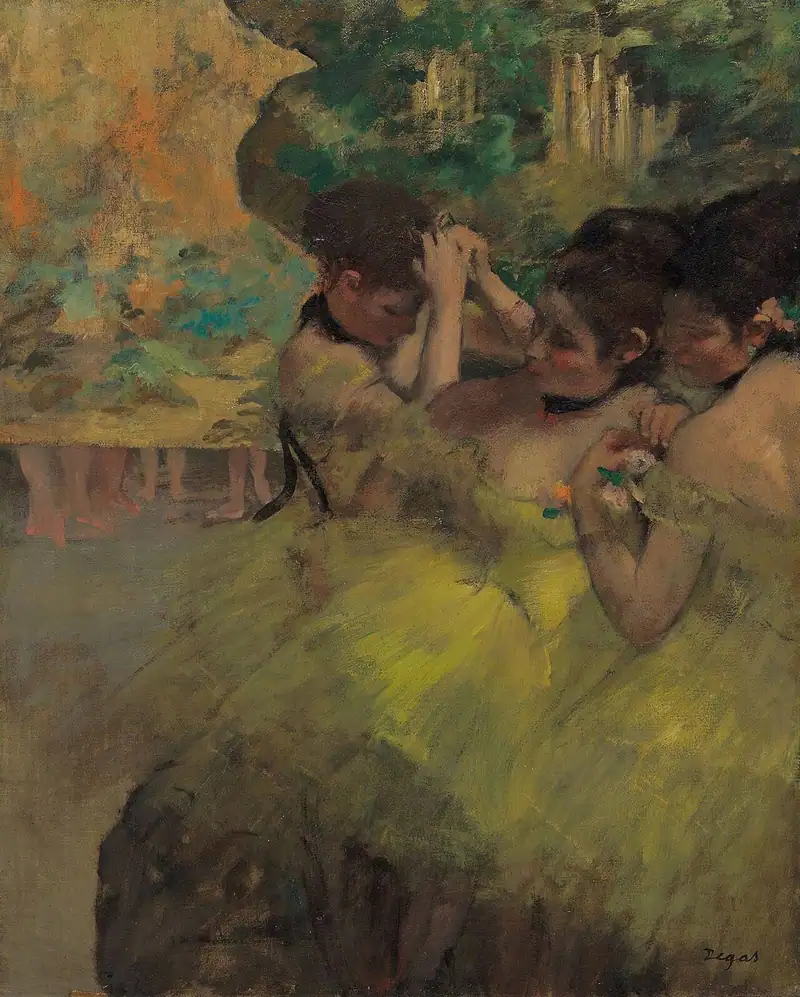
Yellow Dancers (In the Wings)
Hilaire Germain Edgar Degas · 1874–76
- Artist
- Edgar Degas (French, 1834–1917)
- Date
- 1874–76
- Medium
- Oil on canvas
- Size
- 73.5 × 59.5 cm (28 15/16 × 23 7/16 in.); Framed: 91.5 × 78.2 × 7 cm (36 × 30 3/4 × 2 3/4 in.)
- Made in
- France
- Style
- Impressionism
- Where to see it
- Art Institute of Chicago
Gift of Mr. and Mrs. Gordon Palmer, Mrs. Bertha P. Thorne, Mr. and Mrs. Arthur M. Wood, and Mrs. Rose M. Palmer · CC0 Public Domain · Art Institute of Chicago · image via Wikimedia Commons · see it at the museum ↗
Updated 13 October 2026 · how we write
Notes from the museum
Edgar Degas first painted dancers as an independent subject in 1871. He was to devote almost half his output as an artist to this subject, observing countless performances and rehearsals at the Paris Opéra. Here he placed the viewer in the wings, as if among the elite Opéra subscribers who roamed and socialized backstage. Dance subjects allowed Degas to contemporize his lifelong interest in showing the human body in complex movement, shifting the scene from ancient history to modern Paris. He finished and signed the present canvas in time for the second Impressionist exhibition, in April 1876.
Text: Art Institute of Chicago (open access). Our full story for this work is coming soon.
Slow Look
- The whole picture Let your eyes wander. Where do they want to rest?
- The light Find the brightest spot. What is it showing you?
- The edges Look at what is half cut off at the borders.
- One small detail Choose one tiny thing and stay with it for a while.
- The whole picture again Step back. Has it changed for you?
About Hilaire Germain Edgar Degas
Edgar Degas (1834-1917) was a French artist who exhibited with the Impressionists but preferred to call himself a realist. He loved movement and modern Paris life, painting and drawing ballet dancers in rehearsal, racehorses, laundresses and cafe scenes, often from unusual angles. He was a master of pastel, which he used more and more as his eyesight weakened. His sculpture Little Dancer Aged Fourteen, shown in 1881, shocked critics with its real fabric tutu, and today its bronze casts are among his most famous works.
Keep reading
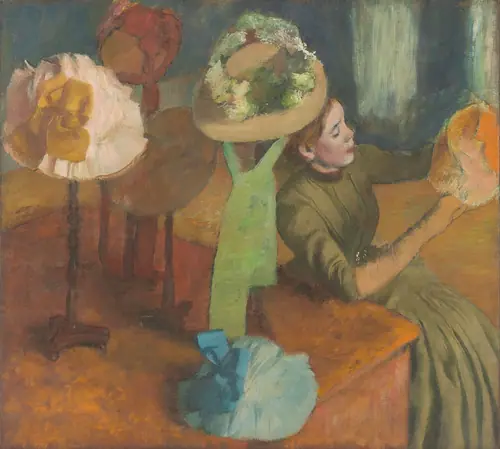
- The Millinery Shop Hilaire Germain Edgar DegasAlso by Hilaire Germain Edgar Degas
- Water Lilies Claude MonetAlso Impressionism
- Paris Street; Rainy Day Gustave CaillebotteAlso Impressionism
What do you see?
Stand in front of it for a moment. Then tell us what you noticed or felt - there are no wrong answers.
Be the first to share a thought.
More by Hilaire Germain Edgar Degas

If you like this, stand in front of these