Inside the Canvas
Tip: move over the painting to use the lens.
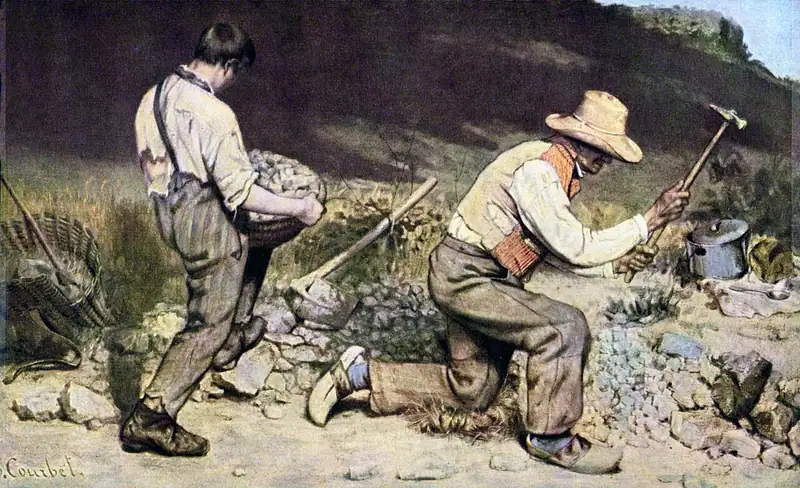
The Stone Breakers
Gustave Courbet · 1850
Can a painting of stone breakers change the way we think about art and life?
- Artist
- Gustave Courbet
- Date
- 1850
- Where to see it
- Staatliche Kunstsammlungen Dresden
Staatliche Kunstsammlungen Dresden · Public domain · image via Wikimedia Commons · see it at the museum ↗
Updated 13 October 2026 · how we write
The story
The painting was destroyed, but its significance remains, making it an often-cited example of Realism.
Our perspective
Our own reading of the picture - an opinion, not a fact.
The Stone Breakers is a reminder that even in the most mundane moments, there is beauty and dignity to be found.
It challenges us to slow down and appreciate the hard work and dedication of those who break stones for a living.
It asks us to consider the value we place on different types of work and the people who do them.
Slow Look
- the figures in the foreground Notice how the stone breakers' bodies are bent and worn out from their labor.
- the stone they are breaking See how the stone is rough and unyielding, yet the breakers are determined to shape it.
- the background landscape Notice the vast expanse of land and sky, a reminder of the world beyond the stone breakers' small task.
- the breakers' faces Feel the weariness and exhaustion etched on their faces, yet also a sense of pride and accomplishment.
- the tools and surroundings Notice the simplicity and ruggedness of the tools and surroundings, a testament to the stone breakers' resourcefulness.
About Gustave Courbet
Jean Désiré Gustave Courbet was a French painter who led the Realism movement in 19th-century French painting. Committed to painting only what he could see, he rejected academic convention and the Romanticism of the previous generation of visual artists. His independence set an example that was important to later artists, such as the Impressionists and the Cubists. Courbet occupies an important place in 19th-century French painting as an innovator and as an artist willing to make bold social statements through his work.
Text adapted from Wikipedia, Gustave Courbet, licensed CC BY-SA 4.0.
Keep reading
- Sistine Madonna RaphaelAlso at Staatliche Kunstsammlungen Dresden
- The Birth of Venus Sandro BotticelliShared themes: beauty
- The Hunters in the Snow Pieter Bruegel the ElderShared themes: beauty
What do you see?
Stand in front of it for a moment. Then tell us what you noticed or felt - there are no wrong answers.
Be the first to share a thought.
More by Gustave Courbet
If you like this, stand in front of these