Inside the Canvas
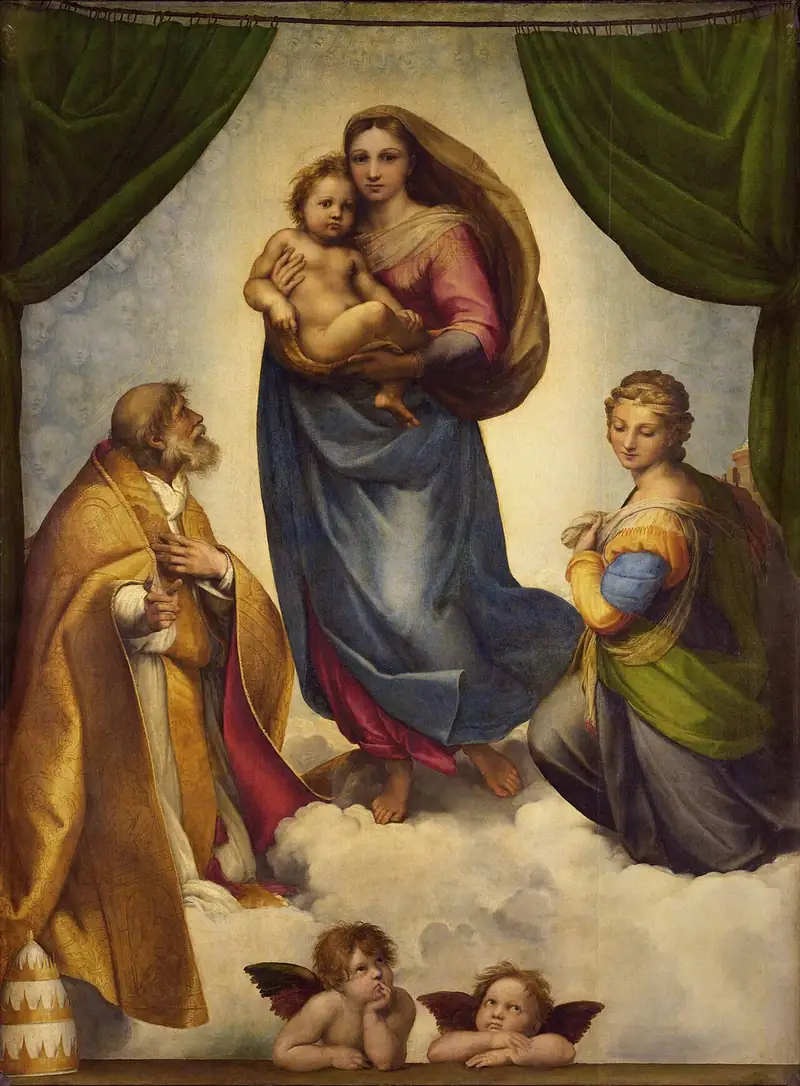
Tip: move over the painting to use the lens.
Sistine Madonna
Raphael · 1512
Is this the most divine mother-and-child pair in art history?
- Artist
- Raphael
- Date
- 1512
- Where to see it
- Staatliche Kunstsammlungen Dresden
Staatliche Kunstsammlungen Dresden · Public domain · image via Wikimedia Commons · see it at the museum ↗
Updated 13 October 2026 · how we write
The story
Raphael's Sistine Madonna is an oil painting commissioned by Pope Julius II in 1512.
Dresden's Old Masters Picture Gallery dates it 1512/13. It was probably finished by February 1513 and stood on the high altar of San Sisto in Piacenza by 1514 at the latest.
The Sistine Madonna is an exceptional piece, as described by Giorgio Vasari as 'a truly rare and extraordinary work'.
It is painted in oil on canvas.
Our perspective
Our own reading of the picture - an opinion, not a fact.
As you stand before the Sistine Madonna, you're enveloped in a sense of serenity, as if the gentle smile of the Virgin Mary is calming your own worries.
This painting asks us to slow down and appreciate the beauty in simplicity, a quality that's often lost in today's fast-paced world.
It's as if Raphael has captured the essence of motherhood – the selfless love, the nurturing, and the peacefulness that surrounds this sacred moment.
Slow Look
- The Virgin's face Notice the subtle smile and the gentle eyes that seem to hold a deep wisdom.
- The Child's gaze Feel the intensity of the Child's stare, as if he's trying to absorb the world around him.
- The folds of the Virgin's robes Marvel at the intricate folds and the way they seem to ripple like the gentle lapping of waves.
- The Child's hands Notice how the Child's hands are placed on the Virgin's robes, as if seeking comfort and security.
- The subtle colors Appreciate the muted color palette, which seems to glow with an inner light, like a warm candle burning in the darkness.
About Raphael
Raphael (1483-1520) was born in Urbino and trained in the circle of the painter Perugino. He worked in Florence from about 1504, then moved to Rome in 1508 to paint for Pope Julius II and later Pope Leo X. His frescoes in the Vatican rooms, including The School of Athens, and his many calm, graceful Madonnas made him famous. He also became chief architect of St Peter's in 1514. He died in Rome at 37, and with Leonardo and Michelangelo he is seen as one of the three great masters of the High Renaissance.
Questions about Sistine Madonna
What should I know about Sistine Madonna?
Raphael's Sistine Madonna is an oil painting commissioned by Pope Julius II in 1512.
Who painted Sistine Madonna?
Sistine Madonna was painted by Raphael.
What is the date of Sistine Madonna?
The museum record dates Sistine Madonna to 1512.
Where can I see Sistine Madonna?
It is in the collection of Staatliche Kunstsammlungen Dresden.
Where is Raphael's Sistine Madonna located in person?
The Sistine Madonna is located at the Staatliche Kunstsammlungen Dresden.
When was the Sistine Madonna by Raphael commissioned?
Raphael's Sistine Madonna was commissioned by Pope Julius II in 1512.
Where is the original Sistine Madonna by Raphael located?
The Sistine Madonna hangs in the Gemaldegalerie Alte Meister (Old Masters Picture Gallery) in Dresden, part of the Staatliche Kunstsammlungen Dresden.
Keep reading
- Lady with an Ermine Leonardo da VinciShared themes: renaissance, serene
- Mona Lisa Leonardo da VinciShared themes: renaissance
- The Birth of Venus Sandro BotticelliShared themes: serene
What do you see?
Stand in front of it for a moment. Then tell us what you noticed or felt - there are no wrong answers.
Be the first to share a thought.
More by Raphael
If you like this, stand in front of these