Inside the Canvas
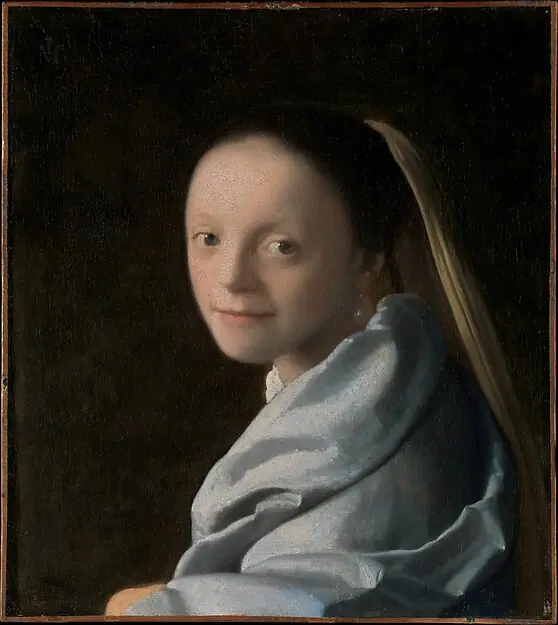
Tip: move over the painting to use the lens.
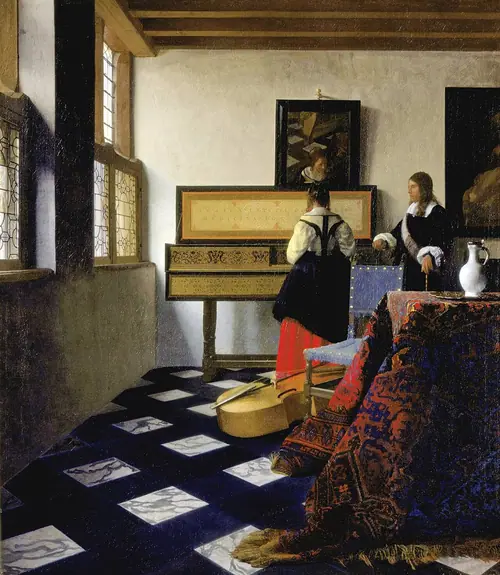
Study of a Young Woman
Johannes Vermeer · ca. 1665–67
Meet a young woman lost in thought, her gaze a window to her soul.
- Artist
- Johannes Vermeer Dutch, Delft 1632–1675 Delft
- Date
- ca. 1665–67
- Medium
- Oil on canvas
- Size
- 17 1/2 x 15 3/4 in. (44.5 x 40 cm)
- Where to see it
- The Metropolitan Museum of Art
Gift of Mr. and Mrs. Charles Wrightsman, in memory of Theodore Rousseau Jr., 1979 · CC0 Public Domain · The Met · see it at the museum ↗
Updated 21 October 2026 · how we write
The story
Created between 1665 and 1667, it now resides in the Metropolitan Museum of Art in New York.
In this piece, Vermeer captures the everyday life of a young woman, her thoughts and emotions laid bare for us to ponder. The artist was renowned for his ability to convey the intimacy of domestic scenes, often featuring ordinary people going about their daily routines.
Vermeer's focus on the inner lives of his subjects was a hallmark of his style, which has come to define the Dutch Golden Age of art.
Our perspective
Our own reading of the picture - an opinion, not a fact.
Standing before this painting, you're struck by the tranquility it exudes. It's as if you've stumbled upon a private moment, one that the young woman is reluctant to share with the world.
In a world that often values noise and activity, this painting reminds us that sometimes the most profound moments are the quiet ones, when our minds are free to wander and reflect.
Slow Look
- At the woman's hands Notice how they're clasped together, a subtle sign of contemplation.
- At the background Observe the soft, feathery textures that create a sense of warmth and coziness.
- At the woman's face Take in the gentle curves of her features, the subtle smile that hints at a deep inner peace.
- At the lighting Marvel at the way the soft, golden light illuminates the scene, casting a sense of serenity over the entire composition.
- At the woman's eyes Get lost in the depths of her gaze, which seems to hold a world of thought and emotion.
About Johannes Vermeer
Johannes Vermeer (1632-1675) spent his whole life in Delft, in the Dutch Republic. He painted quiet rooms: a woman reading a letter, a maid pouring milk, a music lesson, usually lit by soft daylight from a window on the left. Only about 35 paintings are accepted as his today, and he also earned money as an art dealer. After his death he was largely forgotten until French critic Theophile Thore-Burger championed him in the 1860s. He now ranks among the great masters of the Dutch Golden Age.
Questions about Study of a Young Woman
What is known about Study of a Young Woman by Johannes Vermeer?
Created between 1665 and 1667, it now resides in the Metropolitan Museum of Art in New York.
Who is the artist of Study of a Young Woman?
Johannes Vermeer painted Study of a Young Woman.
When did Johannes Vermeer make Study of a Young Woman?
The museum record dates Study of a Young Woman to ca. 1665–67.
Where can I see Study of a Young Woman?
Study of a Young Woman is held by The Metropolitan Museum of Art.
What technique did Johannes Vermeer use for Study of a Young Woman?
Its medium is oil on canvas.
What style is the painting 'A Young Woman' by Johannes Vermeer?
The style is a hallmark of the Dutch Golden Age of art, characterized by its focus on the inner lives of ordinary people.
What significance do the woman's clasped hands have in the painting 'A Young Woman' by Johannes Vermeer?
Vermeer left no notes explaining his pictures, so any meaning in the hands is interpretation. Art historians usually read the stillness of his figures - resting hands and quiet poses - as a sign of calm, inward attention rather than a hidden symbol.
Keep reading
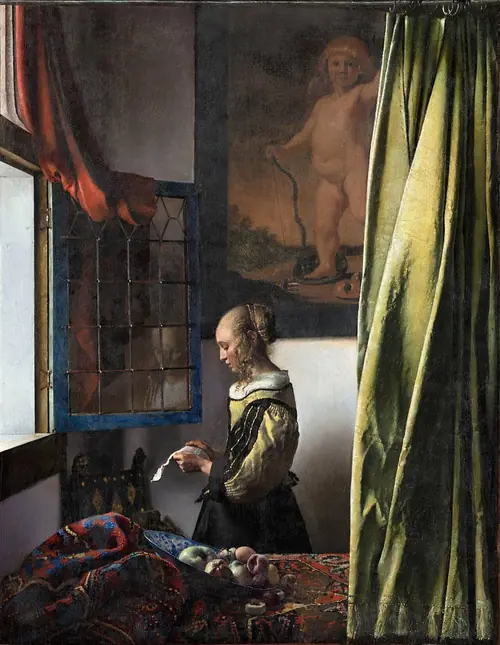
- Girl Reading a Letter at an Open Window Johannes VermeerAlso by Johannes Vermeer
- The Music Lesson Johannes VermeerAlso by Johannes Vermeer
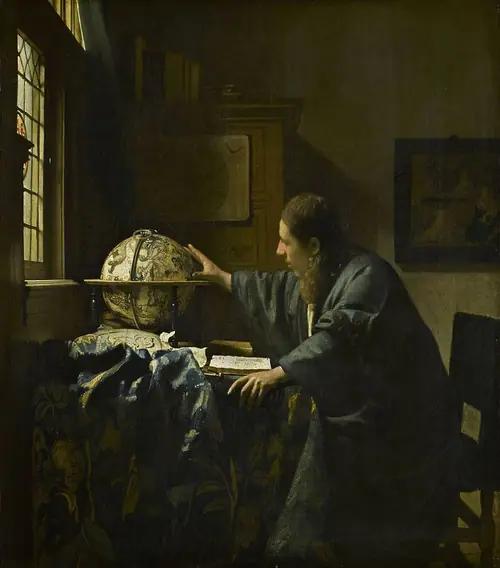
- The Astronomer Johannes VermeerAlso by Johannes Vermeer
What do you see?
Stand in front of it for a moment. Then tell us what you noticed or felt - there are no wrong answers.
Be the first to share a thought.
More by Johannes Vermeer
If you like this, stand in front of these