Inside the Canvas
Tip: move over the painting to use the lens.
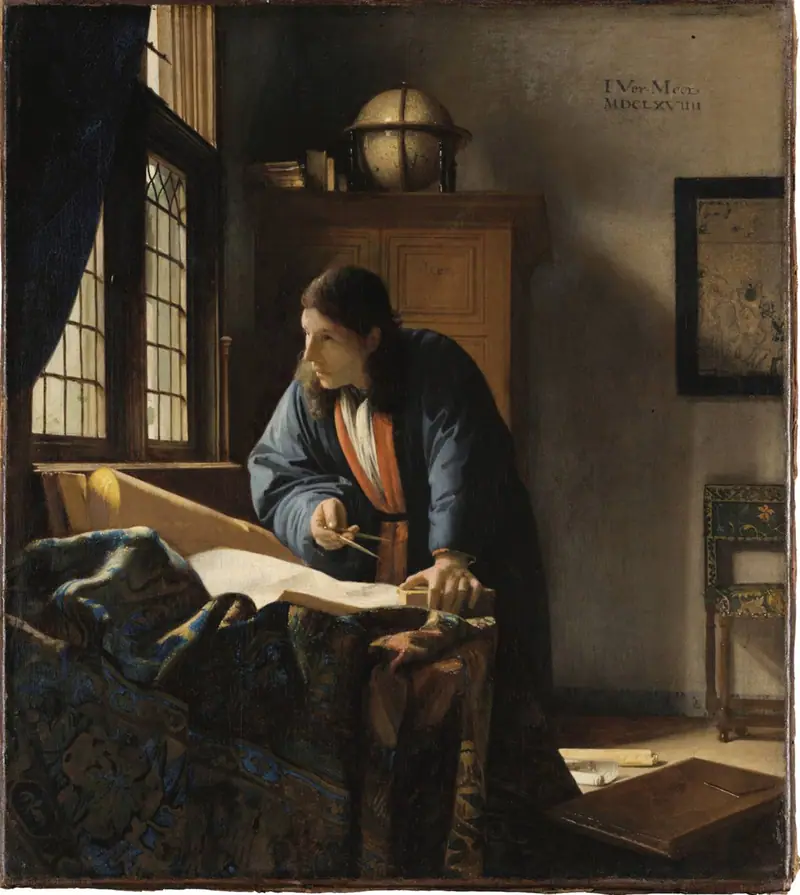
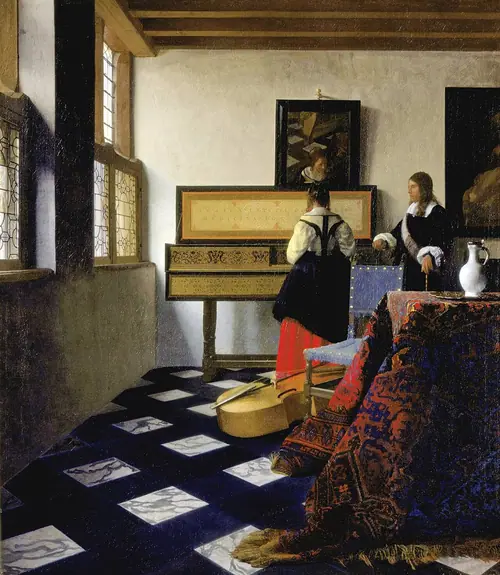
The Geographer
Johannes Vermeer · 1668
Is this quiet scholar mapping the world or losing himself in thought?
- Artist
- Johannes Vermeer
- Date
- 1668
- Where to see it
- Städel Museum
Städel Museum · Public domain · image via Wikimedia Commons · see it at the museum ↗
Updated 19 October 2026 · how we write
The story
Johannes Vermeer's The Geographer is a painting of a man sitting at a desk, surrounded by maps and books. He is thought to be a geographer, given the instruments and charts on his desk. The painting is a domestic interior scene, typical of Vermeer's work. The artist used a similar model to that in The Astronomer, and some consider the two paintings to be pendant pieces.
The Geographer was created in 1668-1669 and is now part of the Städel Museum's collection in Frankfurt, Germany. The painting is closely related to Vermeer's other works, which often depicted middle-class life.
Vermeer was a moderately successful artist during his lifetime, earning a living as an art dealer. He was not wealthy and left his wife in debt at the time of his death.
Our perspective
Our own reading of the picture - an opinion, not a fact.
As we stand before The Geographer, we are drawn into the quiet contemplation of the scholar. His world is one of maps and charts, yet we sense a deeper longing or searching in his eyes. This painting asks us to consider the role of knowledge and exploration in our own lives.
In a world where our eyes are constantly glued to screens, this painting invites us to slow down and appreciate the beauty of the physical world. The Geographer reminds us that even in the quiet moments, there is always more to discover.
Slow Look
- The desk and instruments Notice the intricate details of the scholar's workspace, and the sense of order and precision that it brings.
- The maps and books Take in the wealth of knowledge and discovery that surrounds the scholar, and the sense of adventure that it inspires.
- The scholar's hands Observe the gentle touch of the scholar's hands on the instruments, and the sense of reverence and care that it implies.
- The background Look beyond the scholar to the subtle shading and texture of the background, and the sense of depth and dimensionality that it adds.
- The scholar's face Gaze into the scholar's eyes, and sense the quiet contemplation and introspection that lies beneath the surface.
About Johannes Vermeer
Johannes Vermeer (1632-1675) spent his whole life in Delft, in the Dutch Republic. He painted quiet rooms: a woman reading a letter, a maid pouring milk, a music lesson, usually lit by soft daylight from a window on the left. Only about 35 paintings are accepted as his today, and he also earned money as an art dealer. After his death he was largely forgotten until French critic Theophile Thore-Burger championed him in the 1860s. He now ranks among the great masters of the Dutch Golden Age.
Questions about The Geographer
What is the story behind The Geographer?
Johannes Vermeer's The Geographer is a painting of a man sitting at a desk, surrounded by maps and books. He is thought to be a geographer, given the instruments and charts on his desk. The painting is a domestic interior scene, typical of Vermeer's work.
Which artist painted The Geographer?
The artist of The Geographer is Johannes Vermeer.
What is the date of The Geographer?
Johannes Vermeer's The Geographer is dated 1668 in the museum record.
Where is The Geographer today?
It is in the collection of Städel Museum.
What is notable about the scholar's workspace in The Geographer?
The workspace shows a sense of order and precision.
When was the Geographer painting by Vermeer created?
The Geographer was created in 1668-1669.
Keep reading
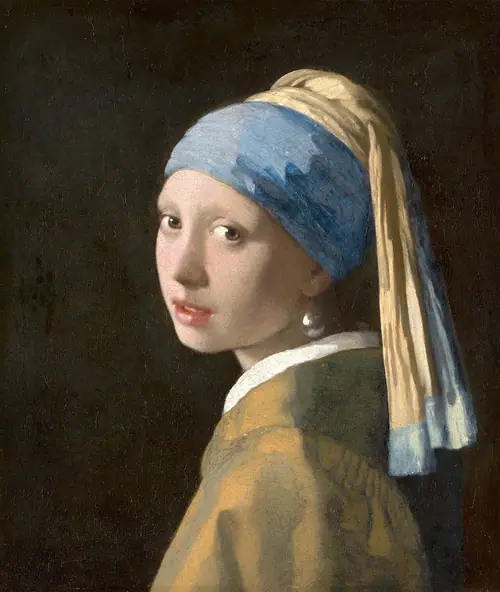
- Girl with a Pearl Earring Johannes VermeerAlso by Johannes Vermeer
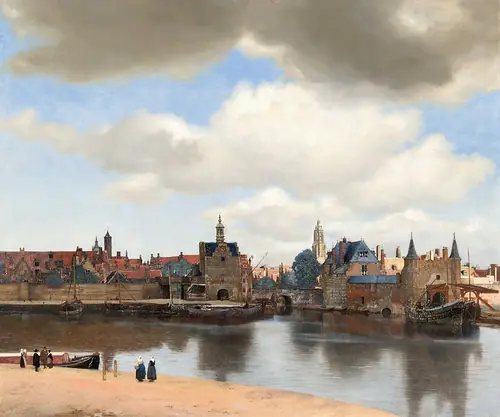
- View of Delft Johannes VermeerAlso by Johannes Vermeer
- Girl Reading a Letter at an Open Window Johannes VermeerAlso by Johannes Vermeer
What do you see?
Stand in front of it for a moment. Then tell us what you noticed or felt - there are no wrong answers.
Be the first to share a thought.
More by Johannes Vermeer
If you like this, stand in front of these