Inside the Canvas
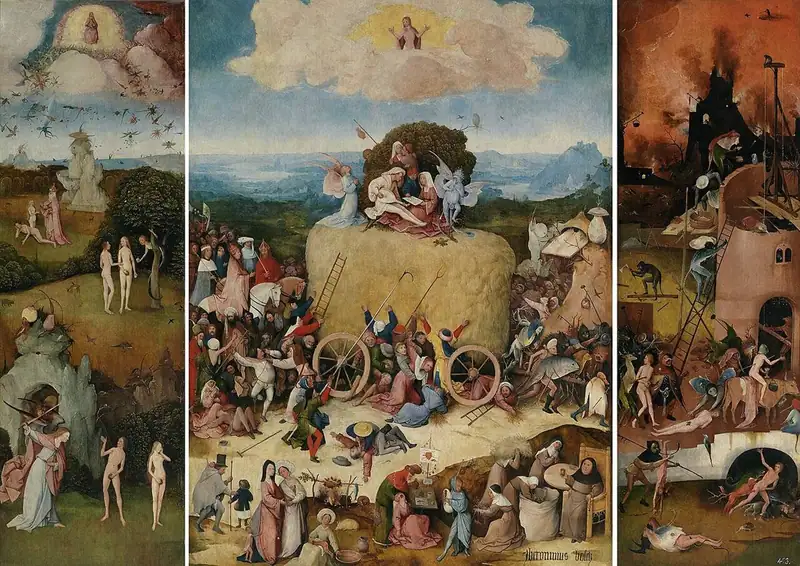
Tip: move over the painting to use the lens.
The Haywain Triptych
Hieronymus Bosch · 1510
What secrets lie hidden in the haywain's rustic charm?
- Artist
- Hieronymus Bosch
- Date
- 1510
- Where to see it
- Museo del Prado
Museo del Prado · Public domain · image via Wikimedia Commons · see it at the museum ↗
Updated 13 October 2026 · how we write
The story
It measures 135 cm × 200 cm, with wings measuring 147 cm × 66 cm. The central panel is signed 'Jheronimus Bosch'.
It features a central panel and two outside shutters, with a full-color version of 'The Wayfarer' on the outside.
The Haywain Triptych is a masterpiece of the Early Netherlandish painting school, characterized by its fantastical illustrations of religious concepts and narratives.
Our perspective
Our own reading of the picture - an opinion, not a fact.
As we stand before this triptych, we're transported to a world where the mundane and the surreal coexist. It's as if Bosch has taken the ordinary and turned it into a metaphor for the extraordinary.
The Haywain Triptych asks us to consider the nature of reality and our place within it. Are we just passive observers, or can we influence the journey?
Slow Look
- The central panel's haywain Notice how the haywain's rustic charm belies the fantastical creatures lurking within.
- The figures on the haywain Observe the figures' expressions, their postures, and the stories they tell.
- The wings' depictions Pay attention to the vivid colors and detailed illustrations on the wings.
- The outer shutters' version of 'The Wayfarer' Notice how the full-color version of 'The Wayfarer' adds depth and context to the central panel.
- The painting's edges Look at the way the edges of the painting seem to fade away, drawing our attention to the central panel.
About Hieronymus Bosch
Hieronymus Bosch was a Dutch painter from Brabant. He is one of the most notable representatives of the Early Netherlandish painting school. His work, generally oil on oak wood, mainly contains fantastic illustrations of religious concepts and narratives. Within his lifetime, his work was collected in the Netherlands, Austria, and Spain, and widely copied, especially his macabre and nightmarish depictions of hell.
Text adapted from Wikipedia, Hieronymus Bosch, licensed CC BY-SA 4.0.
Questions about The Haywain Triptych
What is the story behind The Haywain Triptych?
It measures 135 cm × 200 cm, with wings measuring 147 cm × 66 cm. The central panel is signed 'Jheronimus Bosch'.
Who painted The Haywain Triptych?
Hieronymus Bosch painted The Haywain Triptych.
What is the date of The Haywain Triptych?
The Haywain Triptych is dated 1510.
Where can I see The Haywain Triptych?
You can see it at Museo del Prado, which holds it in its collection.
Where is the Haywain Triptych currently located, and what is its size and medium?
The Haywain Triptych is in the Museo del Prado, measuring 135 cm × 200 cm, with wings measuring 147 cm × 66 cm.
What are the main themes and narratives depicted in the Haywain Triptych?
The Haywain Triptych features fantastical illustrations of religious concepts and narratives, characteristic of the Early Netherlandish painting school.
Keep reading
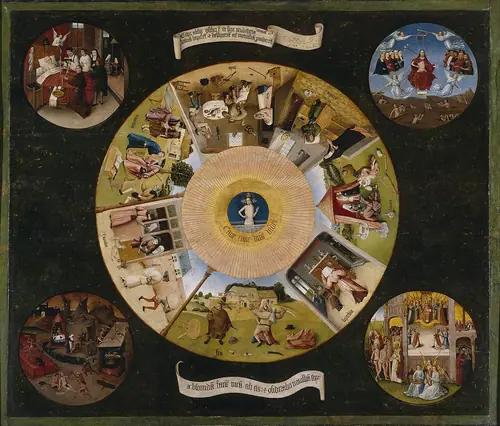
- The Seven Deadly Sins and the Four Last Things Hieronymus BoschAlso by Hieronymus Bosch
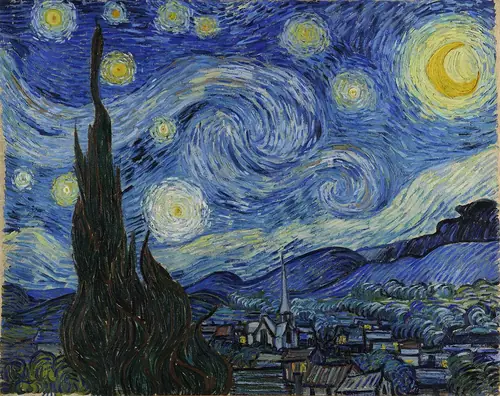
- The Starry Night Vincent van GoghShared themes: dreamy, whimsical
- Las Meninas Diego VelázquezAlso at Museo del Prado
What do you see?
Stand in front of it for a moment. Then tell us what you noticed or felt - there are no wrong answers.
Be the first to share a thought.
More by Hieronymus Bosch
If you like this, stand in front of these