Inside the Canvas
Tip: move over the painting to use the lens.
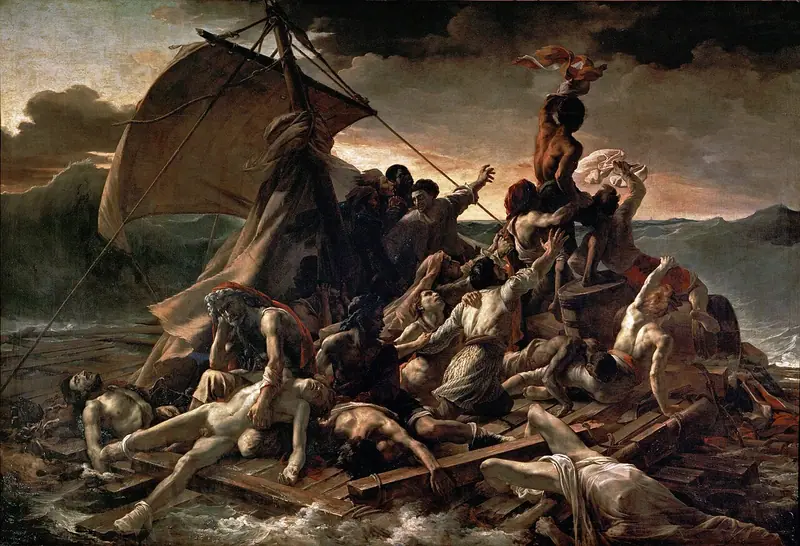
The Raft of the Medusa
Théodore Géricault · 1819
How did the artist convey the horrors of this tragic event?
- Artist
- Théodore Géricault
- Date
- 1819
- Where to see it
- Louvre
Louvre · Public domain · image via Wikimedia Commons · see it at the museum ↗
Updated 13 October 2026 · how we write
Our perspective
Our own reading of the picture - an opinion, not a fact.
As you stand before this massive painting, the chaos and desperation of the scene become palpable.
You can't help but wonder how the survivors must have felt, struggling to stay alive on the rough seas.
It's a powerful reminder that even in the most dire of situations, there is always a glimmer of humanity to be found.
Slow Look
- The central figures Notice the expressions of despair and hopelessness on their faces.
- The sea and the sky Feel the vastness and fury of the ocean, and the emptiness of the sky above.
- The raft's construction Observe the makeshift nature of the raft, and the desperation that drove its creation.
- The figures' clothing Notice the tattered and worn-out clothing, a testament to the survivors' struggles.
- The figure in the distance Look closely at the figure in the distance, and try to read the story behind their face.
About Théodore Géricault
Jean-Louis André Théodore Géricault was a French painter and lithographer. His best-known painting is The Raft of the Medusa. Despite his short life, he was one of the pioneers of the Romantic movement.
Text adapted from Wikipedia, Théodore Géricault, licensed CC BY-SA 4.0.
Keep reading
- Mona Lisa Leonardo da VinciAlso at Louvre
- Water Lilies Claude MonetShared themes: france
- Grande Odalisque Jean-Auguste-Dominique IngresAlso at Louvre
What do you see?
Stand in front of it for a moment. Then tell us what you noticed or felt - there are no wrong answers.
Be the first to share a thought.
If you like this, stand in front of these