Inside the Canvas
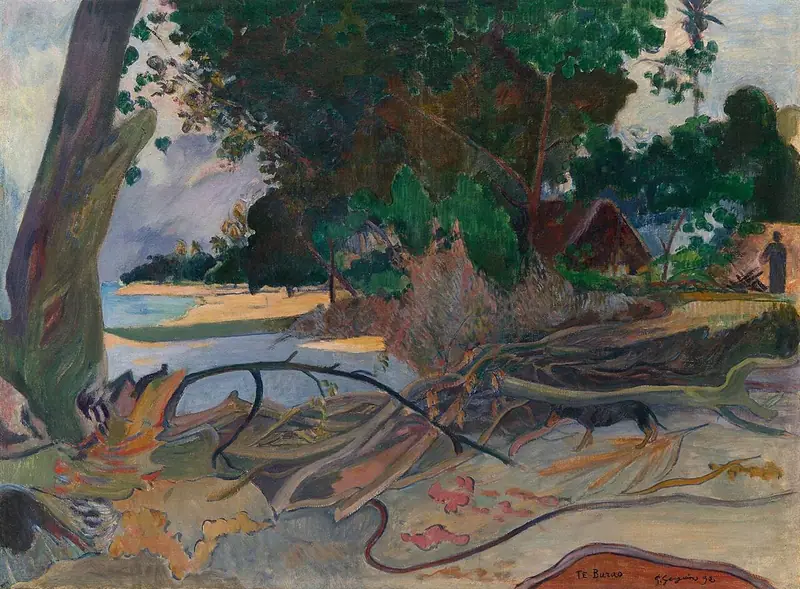
Tip: move over the painting to use the lens.
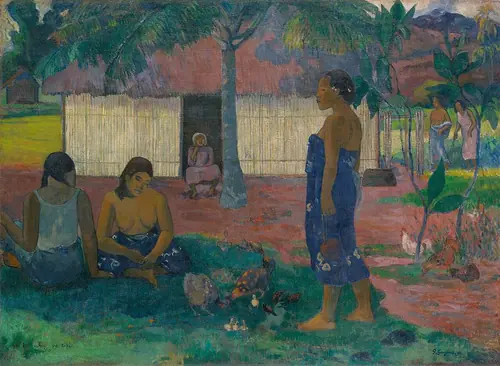
Te burao (The Hibiscus Tree)
Paul Gauguin · 1892
- Artist
- Paul Gauguin (French, 1848–1903)
- Date
- 1892
- Medium
- Oil on canvas
- Size
- 68 × 90.7 cm (26 3/4 × 35 11/16 in.); Framed: 86.4 × 109.3 × 8.9 cm (34 × 43 × 3 1/2 in.)
- Made in
- France
- Style
- Post-Impressionism
- Where to see it
- Art Institute of Chicago
Joseph Winterbotham Collection · CC0 Public Domain · Art Institute of Chicago · image via Wikimedia Commons · see it at the museum ↗
Updated 13 October 2026 · how we write
Notes from the museum
Completed early in Paul Gauguin’s first Tahitian sojourn, this landscape shows the artist grappling with representing an unfamiliar environment. Rather than documenting botanical species scientifically, Gauguin focused on the artistic potential of their variegated colors, textures, and forms. The human figure in the distance and the dog roaming through fallen branches activate the landscape and establish a sense of scale. This is one of thirty-five works that comprise the Winterbotham Collection. Click here to learn more about the collection.
Text: Art Institute of Chicago (open access). Our full story for this work is coming soon.
Slow Look
- The whole picture Let your eyes wander. Where do they want to rest?
- The light Find the brightest spot. What is it showing you?
- The edges Look at what is half cut off at the borders.
- One small detail Choose one tiny thing and stay with it for a while.
- The whole picture again Step back. Has it changed for you?
About Paul Gauguin
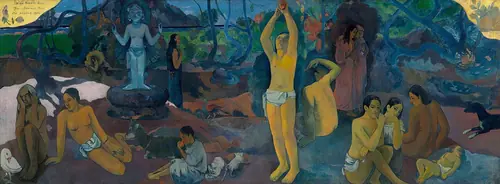
Paul Gauguin (1848-1903) worked as a stockbroker in Paris before turning to painting full time in his thirties. After exhibiting with the Impressionists, he developed a bolder style of flat, strong colour and simplified shapes in Pont-Aven, Brittany, and spent a short, stormy stay with Van Gogh in Arles in 1888. In 1891 he left for Tahiti and later the Marquesas Islands, where he died in 1903. His large late work Where Do We Come From? What Are We? Where Are We Going? hangs in the Museum of Fine Arts, Boston.
Keep reading
- Where Do We Come From? What Are We? Where Are We Going? Paul GauguinAlso by Paul Gauguin
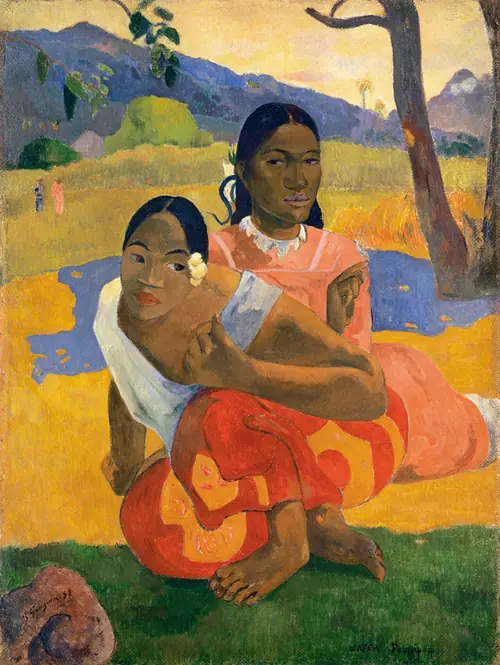
- When Will You Marry? Paul GauguinAlso by Paul Gauguin
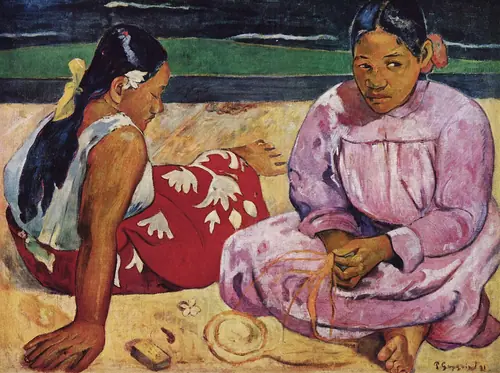
- Tahitian Women on the Beach Paul GauguinAlso by Paul Gauguin
What do you see?
Stand in front of it for a moment. Then tell us what you noticed or felt - there are no wrong answers.
Be the first to share a thought.
More by Paul Gauguin
If you like this, stand in front of these