Inside the Canvas
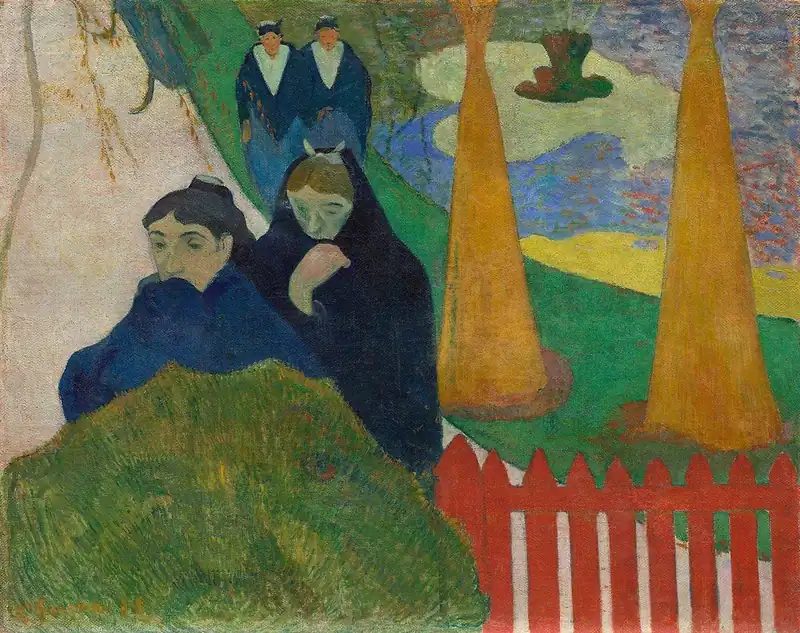
Tip: move over the painting to use the lens.
Arlésiennes (Mistral)
Paul Gauguin · 1888
- Artist
- Paul Gauguin (French, 1848–1903)
- Date
- 1888
- Medium
- Oil on jute canvas
- Size
- 73 × 92 cm (28 3/4 × 36 3/16 in.); Framed: 97.5 × 116.6 × 8 cm (38 3/8 × 45 7/8 × 3 1/8 in.)
- Made in
- France
- Style
- Post-Impressionism
- Where to see it
- Art Institute of Chicago
Mr. and Mrs. Lewis Larned Coburn Memorial Collection · CC0 Public Domain · Art Institute of Chicago · image via Wikimedia Commons · see it at the museum ↗
Updated 13 October 2026 · how we write
Notes from the museum
During the winter of 1888, Paul Gauguin spent a troubled two months with Vincent van Gogh in the southern French city of Arles. He painted the enigmatic Arlésiennes (Mistral) during this stay. The painters’ time together was intended to be the beginning of an artist’s colony, but their relationship grew increasingly tense, and Van Gogh’s mental health deteriorated. Set directly across the street from the house they shared, the painting depicts four women somberly processing through a public garden. The space is tilted radically upward, and complex, three-dimensional forms are reduced to simple, flat shapes. For example, twin orange-yellow cones—probably protective hay coverings to shield plants from the frost—tower at the right like abstracted human figures. Wrapped in dark shawls, the two closest women cover their mouths against the frigid air. Their gestures are withdrawn and introspective, and their passage is seemingly blocked by a bright red fence and large green bush. Perhaps the composition’s oddest element is the appearance of a face within the bush. This face—an intentional inclusion by the artist—adds an uncanny, watchful presence to the scene. It exemplifies Gauguin’s exploration of what he believed to be the mysteries that suffuse everyday life.
Text: Art Institute of Chicago (open access). Our full story for this work is coming soon.
Slow Look
- The whole picture Let your eyes wander. Where do they want to rest?
- The light Find the brightest spot. What is it showing you?
- The edges Look at what is half cut off at the borders.
- One small detail Choose one tiny thing and stay with it for a while.
- The whole picture again Step back. Has it changed for you?
About Paul Gauguin
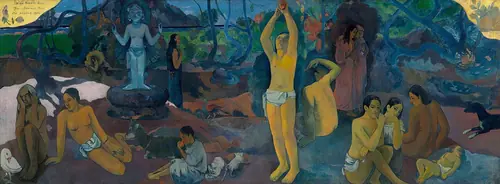
Paul Gauguin (1848-1903) worked as a stockbroker in Paris before turning to painting full time in his thirties. After exhibiting with the Impressionists, he developed a bolder style of flat, strong colour and simplified shapes in Pont-Aven, Brittany, and spent a short, stormy stay with Van Gogh in Arles in 1888. In 1891 he left for Tahiti and later the Marquesas Islands, where he died in 1903. His large late work Where Do We Come From? What Are We? Where Are We Going? hangs in the Museum of Fine Arts, Boston.
Keep reading
- Where Do We Come From? What Are We? Where Are We Going? Paul GauguinAlso by Paul Gauguin
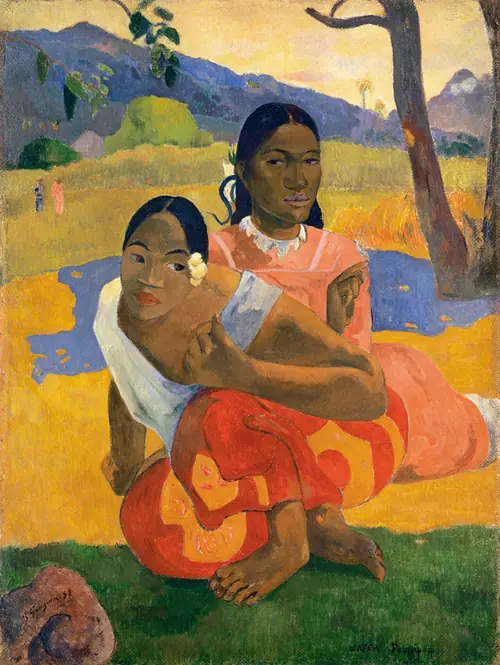
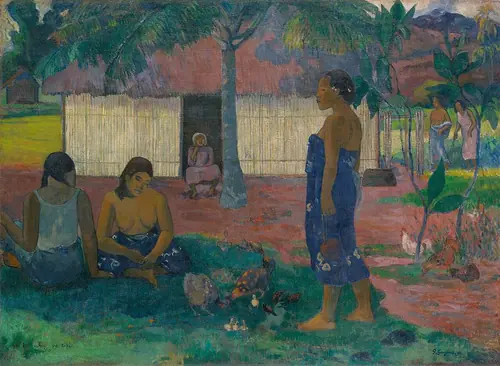
- When Will You Marry? Paul GauguinAlso by Paul Gauguin
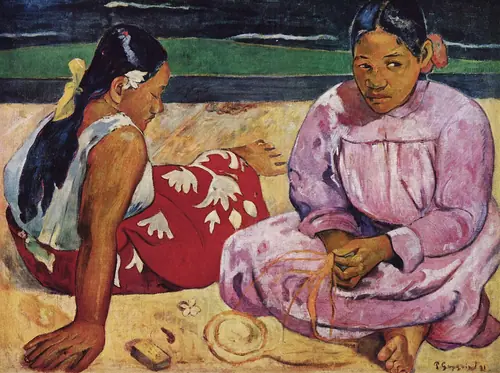
- Tahitian Women on the Beach Paul GauguinAlso by Paul Gauguin
What do you see?
Stand in front of it for a moment. Then tell us what you noticed or felt - there are no wrong answers.
Be the first to share a thought.
More by Paul Gauguin
If you like this, stand in front of these