Tip: move over the painting to use the lens.
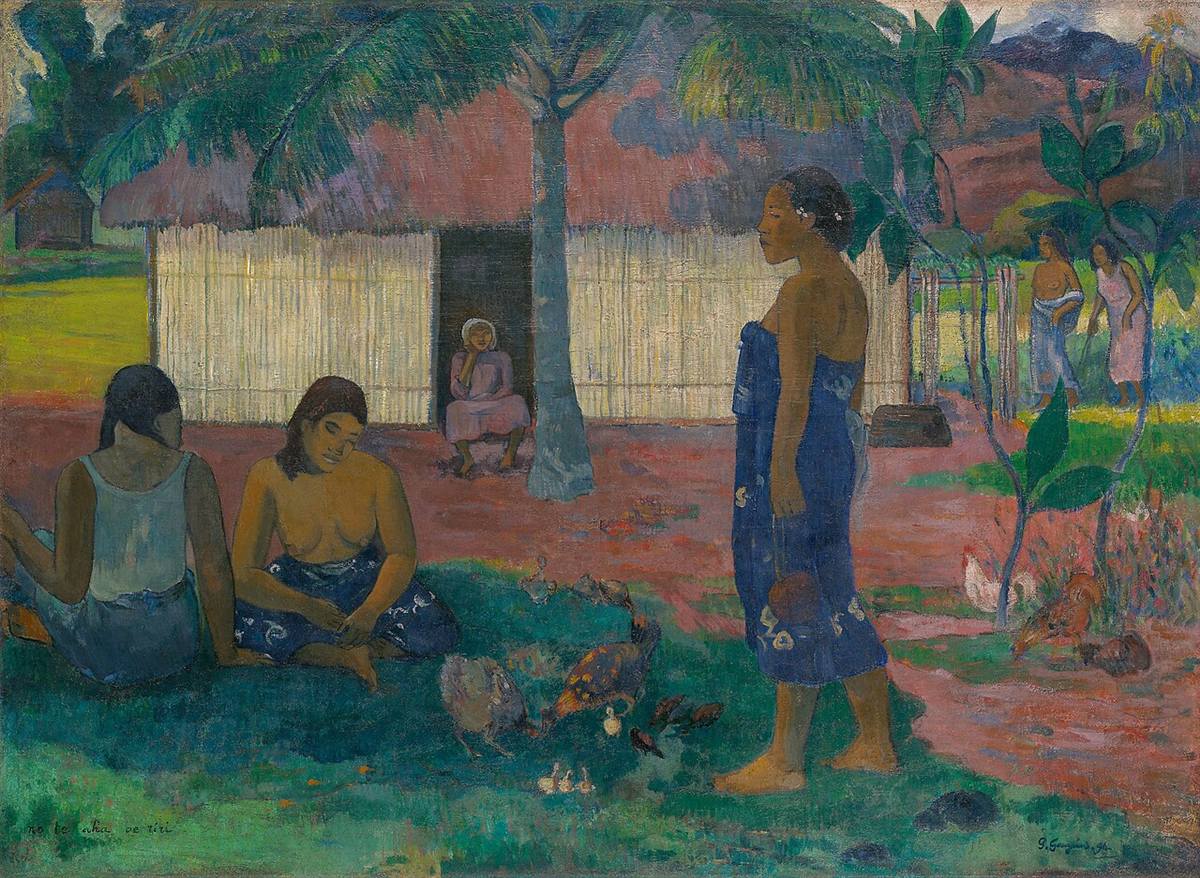
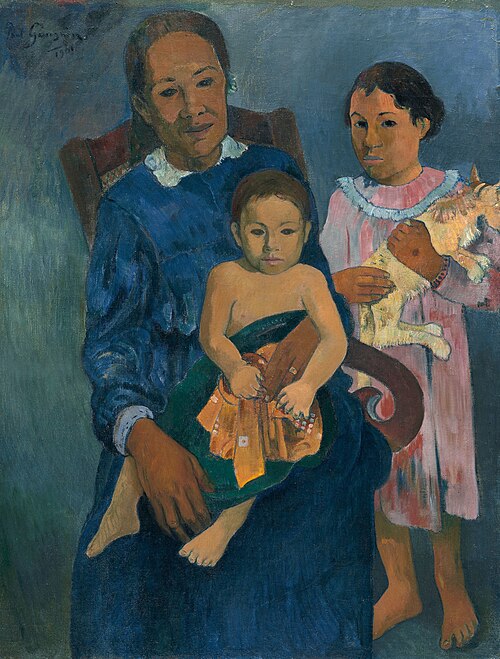
No te aha oe riri (Why Are You Angry?)
Paul Gauguin · 1896
- Artist
- Paul Gauguin (French, 1848–1903)
- Date
- 1896
- Medium
- Oil on jute canvas
- Size
- 95.3 × 130.6 cm (37 1/2 × 51 3/8 in.); Framed: 116.6 × 153.1 × 6.7 cm (45 7/8 × 60 1/4 × 2 5/8 in.)
- Made in
- France
- Style
- Post-Impressionism
- Where to see it
- Art Institute of Chicago
Mr. and Mrs. Martin A. Ryerson Collection · CC0 Public Domain · Art Institute of Chicago · image via Wikimedia Commons · see it at the museum ↗
Notes from the museum
In this large-scale canvas, one of several Paul Gauguin sent back to France in 1897, women of varying ages appear to go about daily life within a colorful, stylized outdoor environment. Like much of the artist’s work, this painting combines observed detail with artistic fantasy to create a dreamlike scene whose narrative resists simple interpretation. The work’s deliberately provocative title enhances this effect, leaving us to wonder if the “you” refers to someone in the painting or to the viewer.
Text: Art Institute of Chicago (open access). Our full story for this work is coming soon.
Slow Look
- The whole picture Let your eyes wander. Where do they want to rest?
- The light Find the brightest spot. What is it showing you?
- The edges Look at what is half cut off at the borders.
- One small detail Choose one tiny thing and stay with it for a while.
- The whole picture again Step back. Has it changed for you?
About Paul Gauguin
Eugène Henri Paul Gauguin was a French painter, sculptor, printmaker, ceramist, and writer, whose work has been primarily associated with the Post-Impressionist and Symbolist movements. He was also an influential practitioner of wood engraving and woodcuts as art forms. While only moderately successful during his lifetime, Gauguin has since been recognized for his experimental use of color and Synthetist style that were distinct from Impressionism.
What do you see?
Stand in front of it for a moment. Then tell us what you noticed or felt - there are no wrong answers.
Be the first to share a thought.
More by Paul Gauguin
If you like this, stand in front of these