Tip: move over the painting to use the lens.
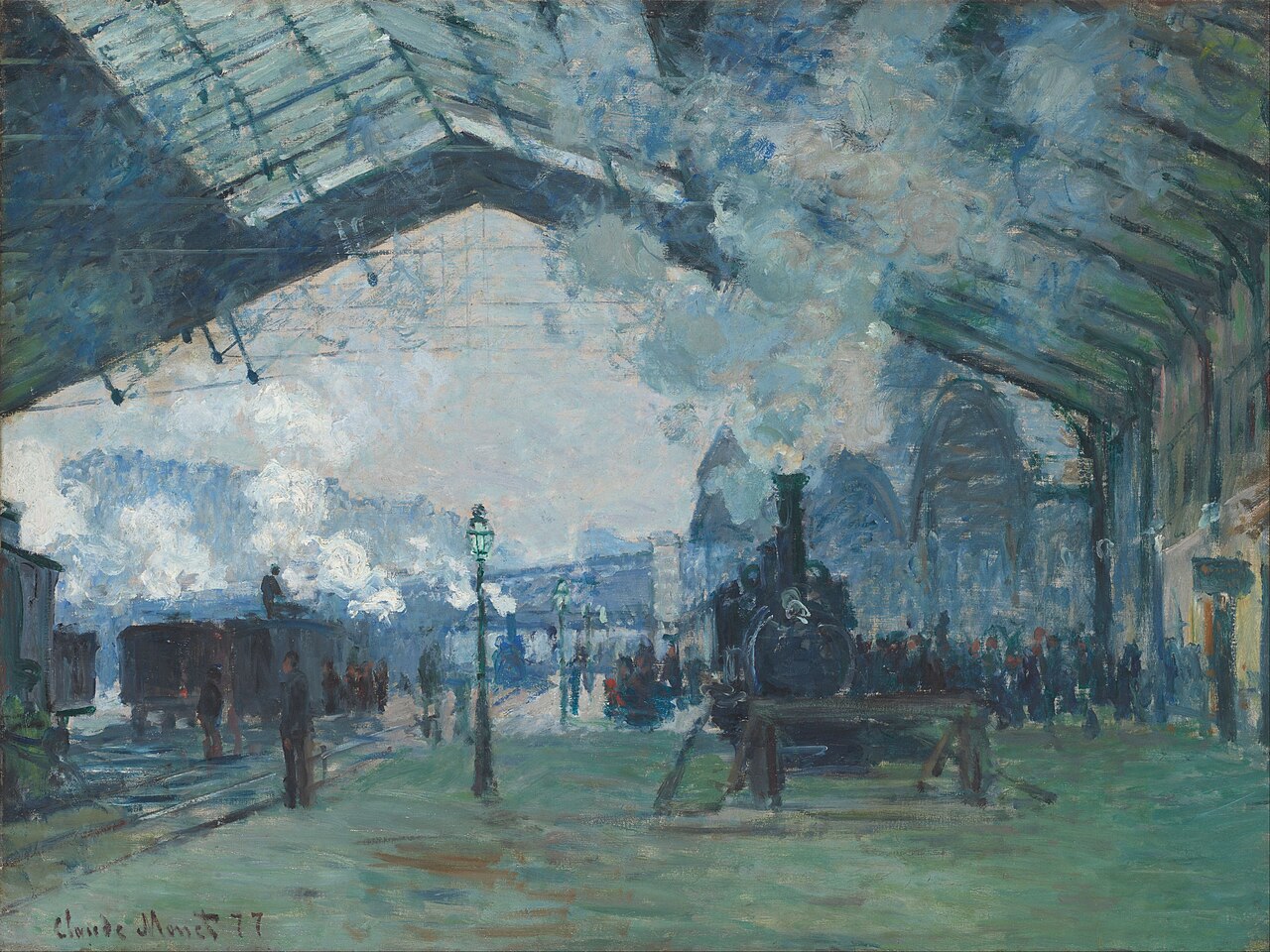
Arrival of the Normandy Train, Gare Saint-Lazare
Claude Monet · 1877
- Artist
- Claude Monet (French, 1840–1926)
- Date
- 1877
- Medium
- Oil on canvas
- Size
- 60.3 × 80.2 cm (23 3/4 × 31 1/2 in.); Framed: 80.7 × 100.4 × 10.2 cm (31 3/4 × 39 1/2 × 4 in.)
- Made in
- France
- Style
- Impressionism
- Where to see it
- Art Institute of Chicago
Mr. and Mrs. Martin A. Ryerson Collection · CC0 Public Domain · Art Institute of Chicago · image via Wikimedia Commons · see it at the museum ↗
Notes from the museum
One of the most avant-garde aspects of the Impressionists was their choice of subject matter, which frequently included scenes derived from modern, industrial Paris, from iron bridges to exhibition halls to train sheds. The train station at Saint-Lazare would have been a familiar, meaningful sight to Claude Monet in the 1870s. The terminal linked Paris to Normandy, where the artist developed his technique of painting outdoors in the 1860s. It was also the point of departure for the towns and villages west and north of Paris that the Impressionists frequently visited. Monet completed eight of his twelve known paintings of the Gare Saint-Lazare in time for the third Impressionist exhibition, in 1877, probably displaying them in the same gallery. Monet chose to focus his attention here on the glass-and-iron train shed, where he found an appealing combination of artifi cial and natural effects—the rising steam of locomotives trapped within the structure and the daylight penetrating large, glazed sections of the roof, for instance. Monet’s depictions of the station inaugurated what was to become for him an established pattern of painting a specific motif repeatedly in order to capture subtle and temporal atmospheric changes, as in his famous series of stacks of wheat . But the Saint-Lazare paintings also represented his last attempt to capture urban life: from this point on in his car
Text: Art Institute of Chicago (open access). Our full story for this work is coming soon.
Slow Look
- The whole picture Let your eyes wander. Where do they want to rest?
- The light Find the brightest spot. What is it showing you?
- The edges Look at what is half cut off at the borders.
- One small detail Choose one tiny thing and stay with it for a while.
- The whole picture again Step back. Has it changed for you?
About Claude Monet
Oscar-Claude Monet was a French painter and founder of Impressionism who is seen as a key precursor to modernism, especially in his attempts to paint nature as he perceived it. During his long career, he was the most consistent and prolific practitioner of Impressionism's philosophy of expressing one's perceptions of nature, especially as applied to plein air (outdoor) landscape painting. The term "Impressionism" is derived from the title of his painting Impression, Sunrise, which was exhibited in 1874 at the First Impressionist Exhibition, initiated by Monet and a number of like-minded artist
What do you see?
Stand in front of it for a moment. Then tell us what you noticed or felt - there are no wrong answers.
Be the first to share a thought.
More by Claude Monet
If you like this, stand in front of these