Tip: move over the painting to use the lens.
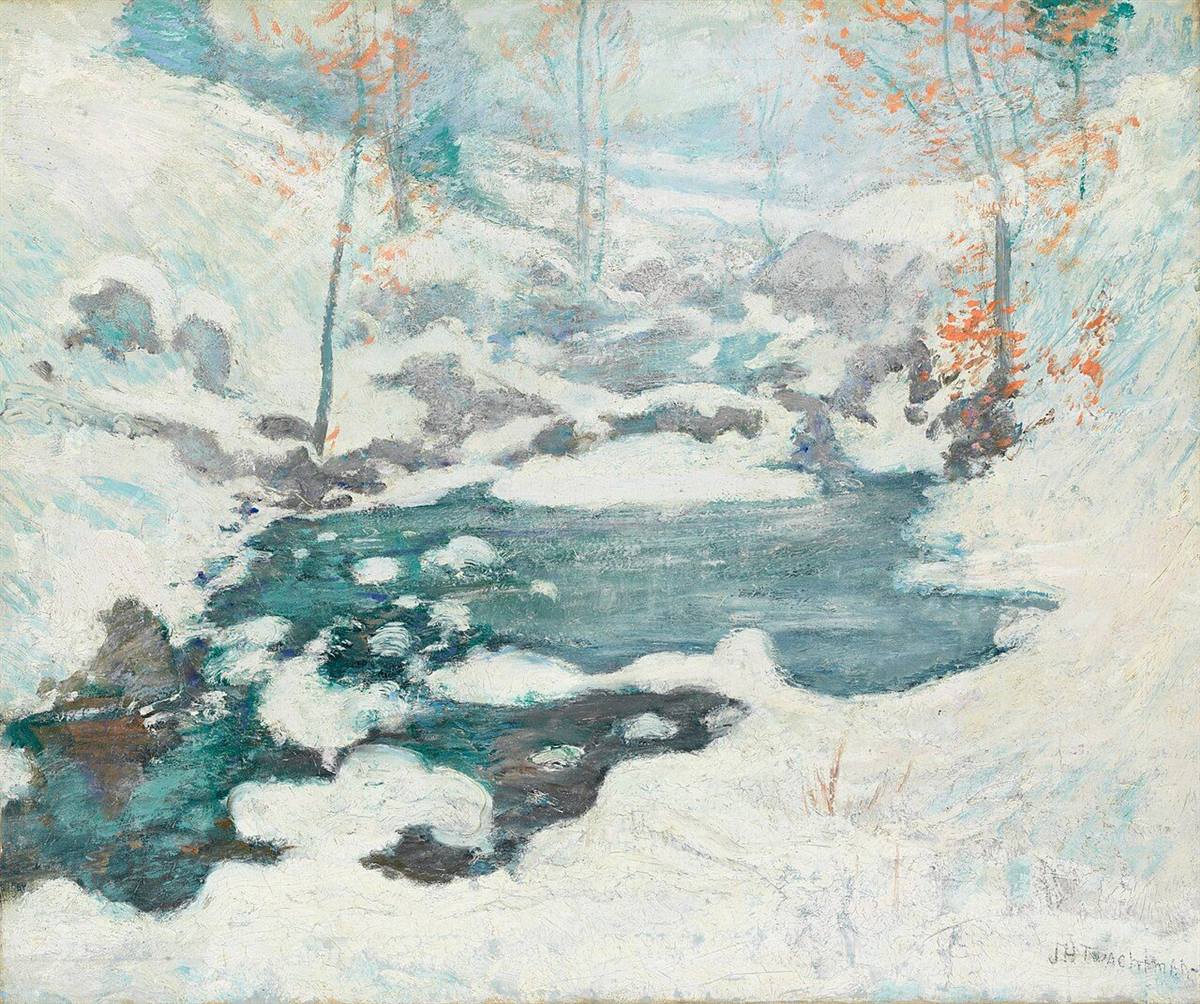
Icebound
John Henry Twachtman · c. 1889
- Artist
- John Henry Twachtman (American, 1853–1902)
- Date
- c. 1889
- Medium
- Oil on canvas
- Size
- 64.2 × 76.6 cm (25 5/16 × 30 3/16 in.)
- Made in
- Greenwich
- Style
- Impressionism
- Where to see it
- Art Institute of Chicago
Friends of American Art Collection · CC0 Public Domain · Art Institute of Chicago · image via Wikimedia Commons · see it at the museum ↗
Notes from the museum
During the last decade of his life, John Henry Twachtman frequently painted views of the landscape surrounding his home in Greenwich, Connecticut. In a departure from typically barren images of winter, he enjoyed depicting the beauty of the frozen terrain, believing that it was conducive to contemplation and regeneration. The dense layers of paint in Icebound mimic the accumulation of snow on frozen ground, and the sinuous curves that define the snow and ice against the water suggest movement in an otherwise tranquil environment. Almost square in format, the painting’s harmonious composition exemplifies Twachtman’s opinion that “never is nature more lovely than when it is snowing.”
Text: Art Institute of Chicago (open access). Our full story for this work is coming soon.
Slow Look
- The whole picture Let your eyes wander. Where do they want to rest?
- The light Find the brightest spot. What is it showing you?
- The edges Look at what is half cut off at the borders.
- One small detail Choose one tiny thing and stay with it for a while.
- The whole picture again Step back. Has it changed for you?
About John Henry Twachtman
John Henry Twachtman was an American painter best known for his impressionist landscapes, though his painting style varied widely through his career. Art historians consider Twachtman's style of American Impressionism to be among the more personal and experimental of his generation. He was a member of "The Ten," a loosely-allied group of American artists dissatisfied with professional art organizations, who banded together in 1898 to exhibit their works as a stylistically unified group.
What do you see?
Stand in front of it for a moment. Then tell us what you noticed or felt - there are no wrong answers.
Be the first to share a thought.
If you like this, stand in front of these