Tip: move over the painting to use the lens.
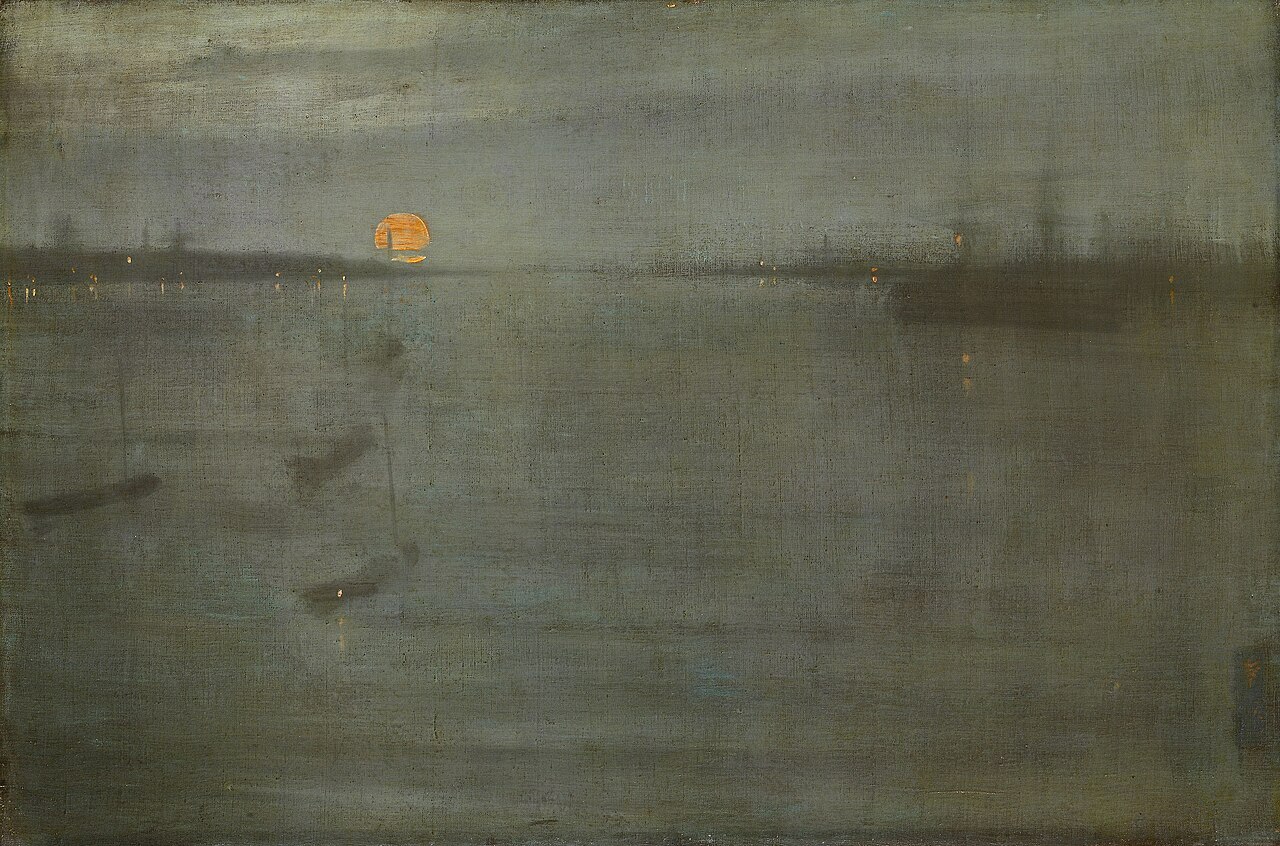
Nocturne: Blue and Gold—Southampton Water
James McNeill Whistler · 1872
- Artist
- James McNeill Whistler (American, 1834–1903)
- Date
- 1872
- Medium
- Oil on canvas
- Size
- 51 × 76.7 cm (20 1/16 × 30 3/16 in.)
- Made in
- London
- Style
- Impressionism
- Where to see it
- Art Institute of Chicago
Stickney Fund · CC0 Public Domain · Art Institute of Chicago · image via Wikimedia Commons · see it at the museum ↗
Notes from the museum
In the early 1870s James McNeill Whistler took a radical step toward abstraction with his Nocturnes series. In keeping with his art-for-art’s-sake creed, these works capture the stillness of evening while evoking a connection to music. Unlike his earlier marine paintings, the subject of this work—an inlet along the English Channel near Southampton—is obscured by the approaching night. Large shipping vessels appear as ghostly shapes, reduced to shadowy forms by the deepening twilight, while the only points of brightness come from the subtle reflections of lights and the fragmented orb of the moon. The setting thus serves primarily as a vehicle for Whistler’s interest in the harmonies of muted color amid darkness.
Text: Art Institute of Chicago (open access). Our full story for this work is coming soon.
Slow Look
- The whole picture Let your eyes wander. Where do they want to rest?
- The light Find the brightest spot. What is it showing you?
- The edges Look at what is half cut off at the borders.
- One small detail Choose one tiny thing and stay with it for a while.
- The whole picture again Step back. Has it changed for you?
About James McNeill Whistler
James Abbott McNeill Whistler was an American painter in oils and watercolor, and printmaker, based primarily in the United Kingdom. He eschewed sentimentality and moral allusion in painting and was a leading proponent of the credo "art for art's sake".
What do you see?
Stand in front of it for a moment. Then tell us what you noticed or felt - there are no wrong answers.
Be the first to share a thought.
More by James McNeill Whistler
If you like this, stand in front of these