Tip: move over the painting to use the lens.
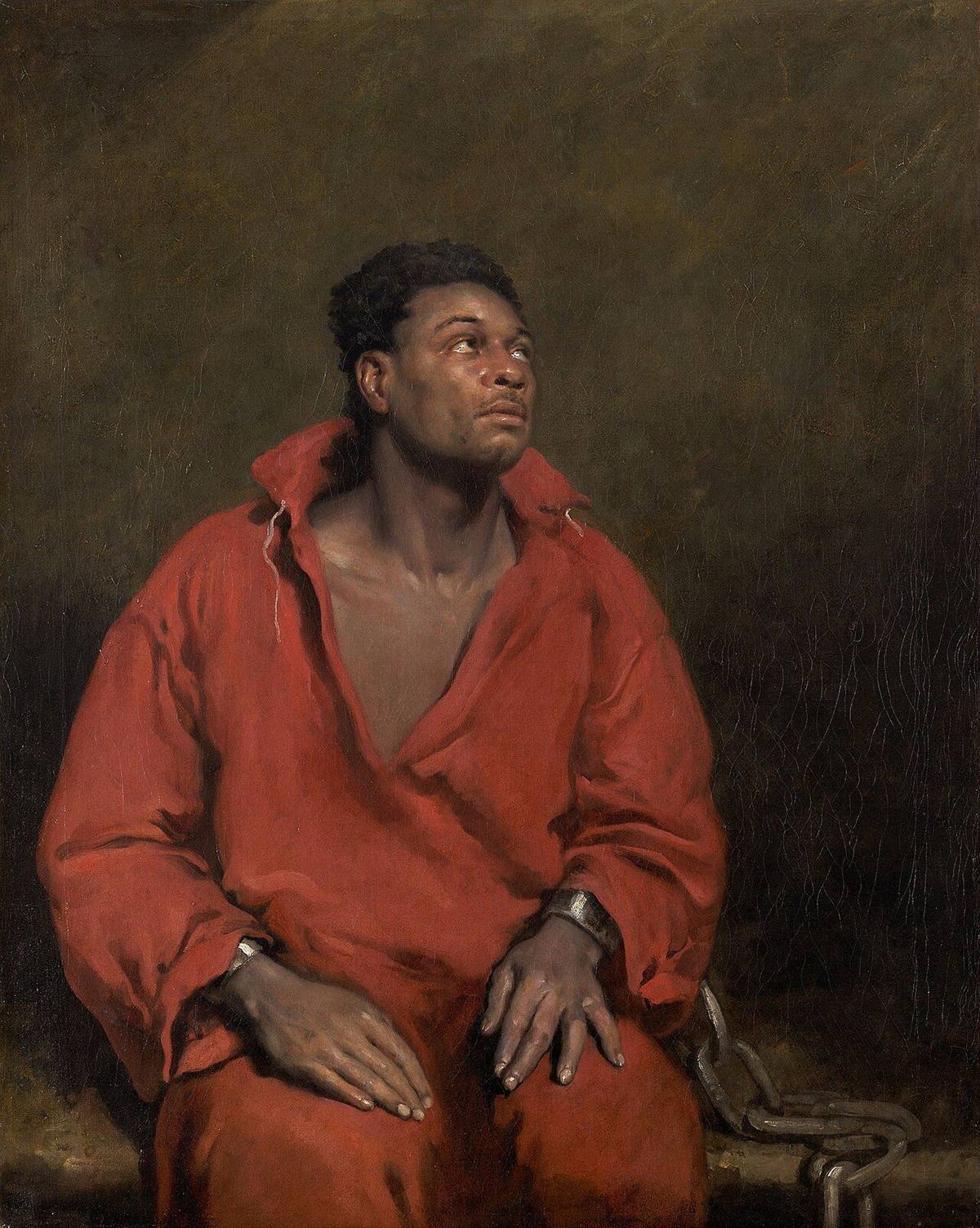
The Captive Slave (Ira Aldridge)
John Philip Simpson · 1827
- Artist
- John Philip Simpson (English, 1782–1847)
- Date
- 1827
- Medium
- Oil on canvas
- Size
- 127 × 101.5 cm (50 × 40 in.); Framed: 167.1 × 141.7 cm (65 3/4 × 55 3/4 in.)
- Made in
- England
- Style
- nineteenth century
- Where to see it
- Art Institute of Chicago
Purchased with funds provided by Mary Winton Green, Dan and Sara Green Cohan, Howard and Lisa Green and Jonathan and Brenda Green, in memory of David Green · CC0 Public Domain · Art Institute of Chicago · image via Wikimedia Commons · see it at the museum ↗
Notes from the museum
In the years leading up to the British Emancipation Act of 1833, this painting of an enslaved man constituted a timely abolitionist appeal. Set against a deeply shadowed background, the figure’s upward gaze suggests a yearning for freedom as he sits manacled to a bench. The composition echoes conventional imagery of Christian saints and martyrs; artist John Philip Simpson used familiar iconography to appeal to the sentimentality of wealthy white viewers with the requisite power to sway public policy. But the deeply moving pose also reflects the artistic contribution of the man who modeled for the figure, now identified as Ira Aldridge, a freeborn American actor famous for playing the title role in Shakespeare’s Othello. His performance in Thomas Morton’s musical drama The Slave may have been the immediate inspiration for Simpson’s painting. Aldridge was also renowned for his impassioned speeches for the abolitionist cause. In 1827, when The Captive Slave was first exhibited at the Royal Academy of Arts in London, the accompanying catalogue included the following excerpt from William Cowper’s 1782 antislavery poem, “Charity”: “But ah! what wish can prosper, or what prayer, / For merchants rich in cargoes of despair.” An engraving of this work, published by Edward Finden in 1827, is also in the Art Institute’s collection.
Text: Art Institute of Chicago (open access). Our full story for this work is coming soon.
Slow Look
- The whole picture Let your eyes wander. Where do they want to rest?
- The light Find the brightest spot. What is it showing you?
- The edges Look at what is half cut off at the borders.
- One small detail Choose one tiny thing and stay with it for a while.
- The whole picture again Step back. Has it changed for you?
About John Philip Simpson
John Philip Simpson was an English painter who specialised in portrait painting.
What do you see?
Stand in front of it for a moment. Then tell us what you noticed or felt - there are no wrong answers.
Be the first to share a thought.
If you like this, stand in front of these