Tip: move over the painting to use the lens.
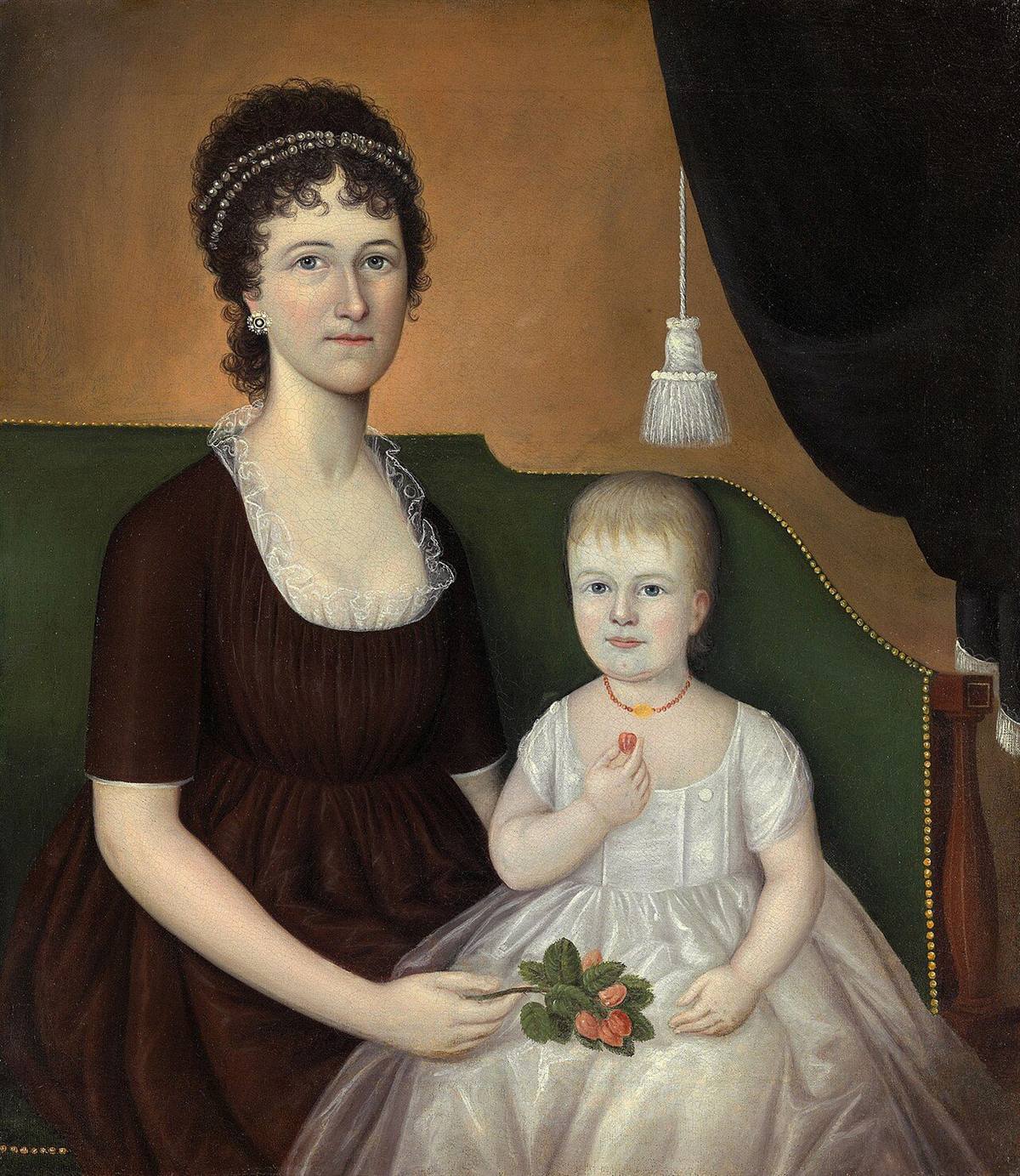
Elizabeth Grant Bankson Beatty (Mrs. James Beatty) and Her Daughter Susan
Joshua Johnson · c. 1805
- Artist
- Joshua Johnson (American, c. 1763–after 1825)
- Date
- c. 1805
- Medium
- Oil on canvas
- Size
- 82.9 × 72.8 cm (32 5/8 × 28 5/8 in.)
- Made in
- Baltimore
- Where to see it
- Art Institute of Chicago
Purchased with funds provided by Robin and Timm R. Reynolds and Jill Burnside Zeno; Bulley and Andrews, Edna Graham, Love Galleries, Mary Swissler Oldberg, Ratcliffe Foundation, and Quinn E. Delaney funds; Walter Aitken, Dr. Julian Archie, Mr. and Mrs. Perry Herst, Jay W. McGreevy, Mr. and Mrs. John W. Puth, Stone Foundation, and Mr. and Mrs. Frederick G. Wacker, Jr. endowment funds; through prior acquisitions of the George F. Harding Collection and Ruth Helgeson · CC0 Public Domain · Art Institute of Chicago · image via Wikimedia Commons · see it at the museum ↗
Notes from the museum
Joshua Johnson portrayed his fashionably dressed sitter Elizabeth Beatty wearing a circlet of glass beads that accentuates her brown hair and gray eyes. The child’s clothes are equally elegant: she sports a high-waisted, white-muslin gown and holds a brightly colored strawberry, a delicacy often featured in the artist’s portraits. Johnson was the first known Black painter to gain professional recognition in the United States. Listed in the 1816 Baltimore city directory as a “free householder of Colour,” he had been freed by his enslaver (and father) around 1782 after apprenticing as a blacksmith. Described as “self-taught” in a newspaper advertisement, Johnson attracted local patrons among the city’s artisan and middle-class families.
Text: Art Institute of Chicago (open access). Our full story for this work is coming soon.
Slow Look
- The whole picture Let your eyes wander. Where do they want to rest?
- The light Find the brightest spot. What is it showing you?
- The edges Look at what is half cut off at the borders.
- One small detail Choose one tiny thing and stay with it for a while.
- The whole picture again Step back. Has it changed for you?
What do you see?
Stand in front of it for a moment. Then tell us what you noticed or felt - there are no wrong answers.
Be the first to share a thought.
If you like this, stand in front of these