Tip: move over the painting to use the lens.
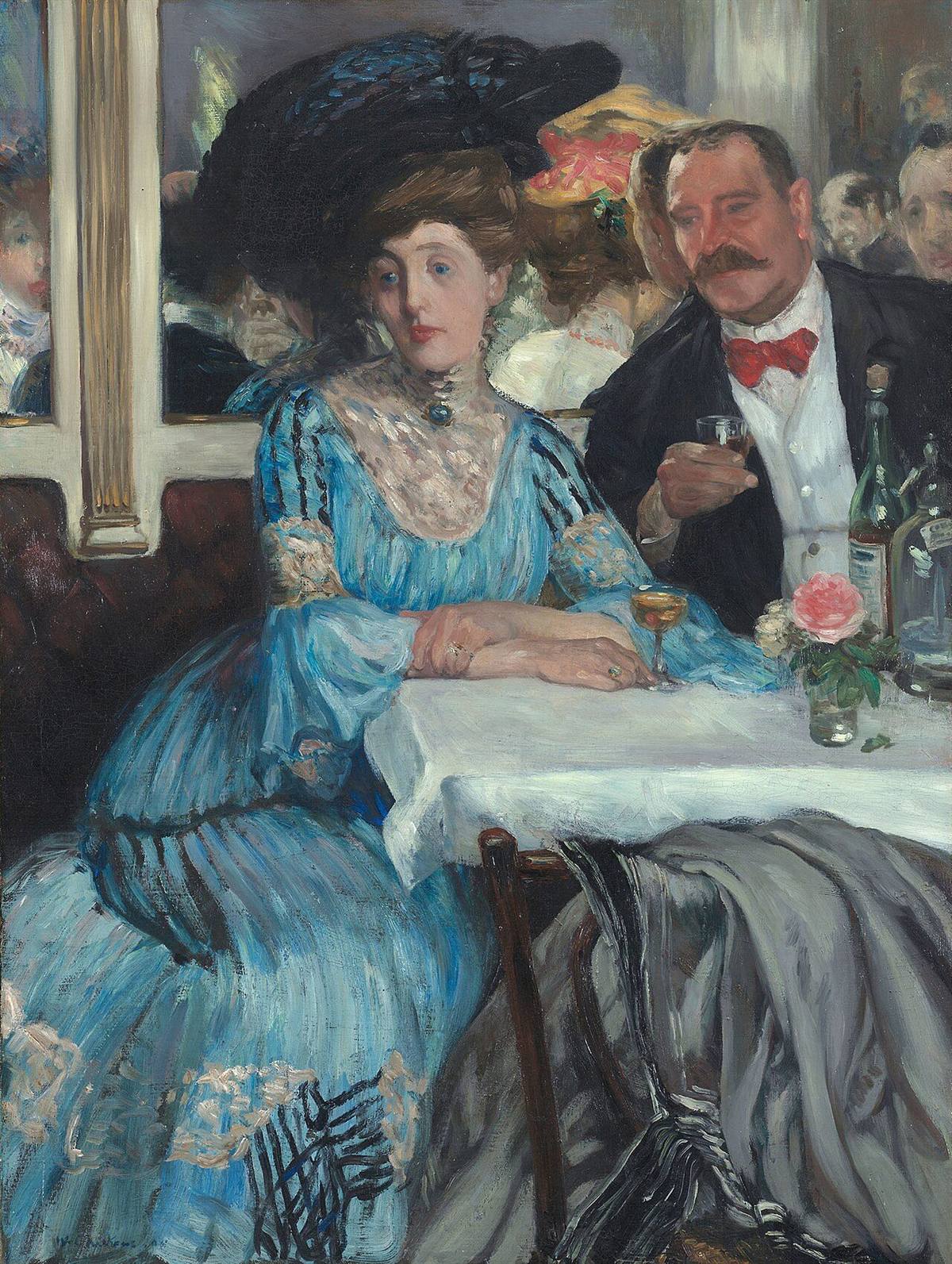
At Mouquin's
William James Glackens · 1905
- Artist
- William Glackens (American, 1870–1938)
- Date
- 1905
- Medium
- Oil on canvas
- Size
- 122.4 × 92.1 cm (48 1/8 × 36 1/4 in.)
- Made in
- United States
- Style
- Impressionism
- Where to see it
- Art Institute of Chicago
Friends of American Art Collection · CC0 Public Domain · Art Institute of Chicago · image via Wikimedia Commons · see it at the museum ↗
Notes from the museum
In this vivid painting, William Glackens portrayed the members of his circle at their favorite meeting place, the New York restaurant Mouquin’s. Jeanne Mouquin, the proprietor’s wife, shares a drink with James B. Moore, a wealthy playboy and restaurateur, while the artist’s wife, Edith, and art critic Charles Fitzgerald are reflected in the mirror behind them. Glackens used vivid brushwork to describe Jeanne Mouquin’s dress, while depicting her with an intent gaze that imbues the scene with tension and mystery. By combining portraiture and everyday scenes, the artist helped usher in a mode of painting suited to the uncertainties and new social activities of modern urban life.
Text: Art Institute of Chicago (open access). Our full story for this work is coming soon.
Slow Look
- The whole picture Let your eyes wander. Where do they want to rest?
- The light Find the brightest spot. What is it showing you?
- The edges Look at what is half cut off at the borders.
- One small detail Choose one tiny thing and stay with it for a while.
- The whole picture again Step back. Has it changed for you?
About William James Glackens
William James Glackens was an American realist painter and one of the founders of the Ashcan School, which rejected the formal boundaries of artistic beauty laid down by the conservative National Academy of Design. He is also known for his work in helping Albert C. Barnes to acquire the European paintings that form the nucleus of the famed Barnes Foundation in Philadelphia. His dark-hued, vibrantly painted street scenes and depictions of daily life in pre-WW I New York and Paris first established his reputation as a major artist. His later work was brighter in tone and showed the strong influe
What do you see?
Stand in front of it for a moment. Then tell us what you noticed or felt - there are no wrong answers.
Be the first to share a thought.
If you like this, stand in front of these